
Find the Right Replacement for Your Deadbolt Assembly
Match a replacement deadbolt latch by model, backset and door preparation. Use open-door tests to separate bolt problems from strike or frame misalignment.
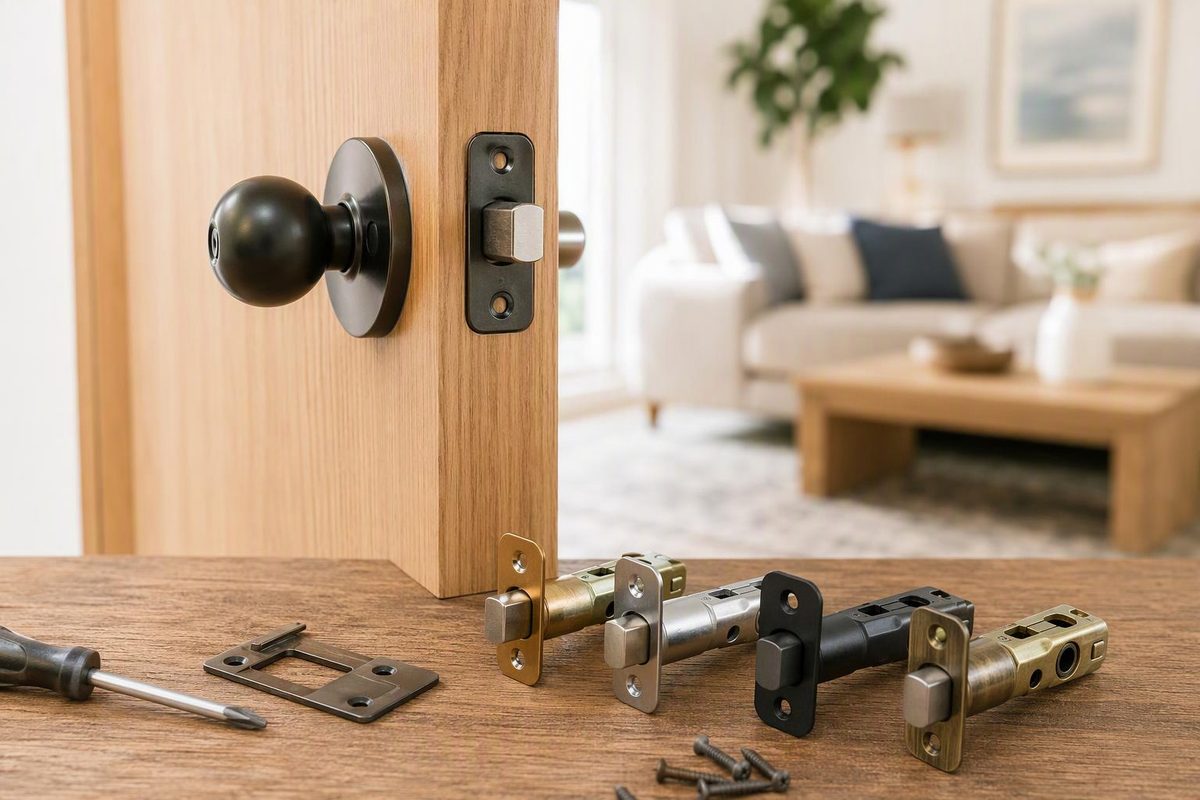
A deadbolt latch usually means the bolt assembly fitted through the edge of a door—not the key cylinder, thumbturn or strike plate. To replace it, match the lock’s manufacturer and model first, then its backset, edge fitting and operating connection. A matching finish or overall length does not establish compatibility.
Before buying a part, test the lock with the door open. A bolt that operates smoothly open but binds closed points toward a strike or door-alignment problem rather than a failed bolt assembly. Retract the bolt before closing the door.
Choose the result of your open-door test to see what to check before ordering.
Deadbolt Fault Check
Retract the bolt before closing the door.
Check Strike Alignment First
Inspect bolt contact with the strike and whether the pocket allows full extension. A replacement bolt may not fix the binding.
This points toward alignment; it does not prove the bolt assembly is fault-free.
Sources: Schlage installation guidance, B60-series instructions (March 2020) and listed motorized-model troubleshooting. Apply corrections only to the documented model.
Identify the Bolt Assembly, Not Just the Listing Name
These similar names describe different mechanisms:
| Part | Identifying Feature |
|---|---|
| Deadbolt | Extends and retracts through the lock mechanism; does not retract when pushed at its end. |
| Latch bolt | Has a beveled end that can be pushed inward as the door closes. |
| Deadlatch | A spring-operated, beveled latch with an auxiliary plunger that prevents push-back when the plunger is depressed. |
| Strike | The plate on the frame that receives the bolt. |
Those distinctions follow BHMA’s hardware terminology. An entry-knob deadlatch is not a replacement for a deadbolt assembly, even if both listings use the word “latch.”
This guide concerns a separate deadbolt installed in round face and edge holes. If the bolt emerges from a large rectangular lock case recessed into the door edge, start with mortise-lock identification; do not order a tubular replacement from backset alone.
Match the Model and Record the Door Preparation
Photograph the lock, the door-edge fitting and any markings. Find the model in the manufacturer’s instructions or parts diagram. If markings are unclear, send those photographs and the measurements below to the manufacturer before choosing a replacement.
| Check | What to Record |
|---|---|
| Backset | Distance from the door edge to the center of the deadbolt’s face hole—not to the edge of its trim. |
| Cross bore | Diameter of the hole through the door face. |
| Edge bore | Diameter of the hole through the door edge. |
| Edge fitting | Rectangular screw-on faceplate or round drive-in collar. For a faceplate, record height, width, corner shape and screw spacing. |
| Operating connection | Tailpiece or other drive connection that engages the bolt mechanism; confirm compatibility in the model’s parts documentation. |
| Bolt throw and strike pocket | How far the bolt projects when fully extended, plus the receiving hole’s dimensions and depth. |
| Door thickness and function | Door thickness; key outside/thumbturn inside, key both sides, or electronic operation. Check any handing or orientation requirements in the instructions. |
Schlage’s terminology guide defines backset and distinguishes the cross bore from the edge bore.
For a documented example, Schlage’s B60/B60CS/B60F/B62 installation sheet, revised March 2020, specifies the following dimensions:
| Dimension | Inches | Millimeters |
|---|---|---|
| Backset | 2-3/8 or 2-3/4 | 60 or 70 |
| Cross bore | 2-1/8 or 1-1/2 | 54 or 38 |
| Edge bore | 1 | 25 |
| Door thickness | 1-3/8 to 1-3/4 | 35–44 |
| Strike-hole depth | At least 1-1/4 | At least 32 |
The smaller cross bore requires the adaptation specified in that sheet. These are requirements for the listed models, not universal deadbolt dimensions. Check the instructions supplied with your lock. An adjustable bolt with two backset settings does not necessarily fit an intermediate measurement.
Same brand is not enough, either. On its drive-in deadbolt latch support page, Kwikset identifies compatibility with the 660 series and names a different drive-in latch, model 83371, for the 780/816/980 series. Confirm the replacement part number for your exact lock.
Open-Door Tests Separate Alignment From Lock Problems
Smooth Open, Binding Closed: Check the Strike
Inspect where the bolt contacts the strike and whether the receiving pocket allows full extension. Schlage’s installation guidance calls for strike or jamb adjustment when the bolt drags or hits the strike with the door closed. Do not assume a new latch will correct that contact.
Binding Open: Check the Model’s Installation
Review the backset setting, tailpiece orientation and possible obstructions before condemning the bolt. The B60-series installation sheet includes a model-specific tailpiece correction when the lock will not operate. That correction is not a universal procedure for other deadbolts.
Key Works Open, Keypad Does Not: Investigate the Electronic Lock
For the motorized models listed in its jam troubleshooting guide, Schlage uses open-door keypad and key tests to distinguish frame preparation from a likely motor issue. Do not buy a mechanical latch solely because the keypad fails to move the bolt; use the troubleshooting instructions for your electronic model.
Replace the Confirmed Part and Test Full Travel
Replacing only the bolt assembly is a reasonable option when the manufacturer confirms a service part and the rest of the lock operates correctly.
Use the manufacturer’s removal and installation sequence. Set the specified backset, fit the correct faceplate or drive-in collar, and follow the bolt and tailpiece orientation shown for that model. Do not transfer an adjustment method from another brand.
When replacing the complete lock, use its supplied components rather than assuming the old bolt and strike remain suitable. Schlage’s motorized-deadbolt troubleshooting guide warns that small product variations can cause jams.
Test full extension and retraction with the door open first, then closed. The bolt should operate smoothly without forcing it against the strike.
Egress and Fire-Door Suitability Require More Than a Fit
Do not change an exit door to a lock requiring a key on the inside without checking applicable requirements. Schlage’s B-Series service manual warns that double-cylinder locks on residences and doors used for egress are a life-safety hazard in emergencies and does not recommend their use.
For fire doors, required exit doors, accessible openings or electrified hardware, verify the complete assembly’s instructions and applicable local requirements before changing parts or function. Matching dimensions alone does not establish suitability.