
Match a Door Lever Spindle by Size, Profile and Function
Measure a door lever spindle across the flats and end to end, then match its retaining features and lock function before replacing it.
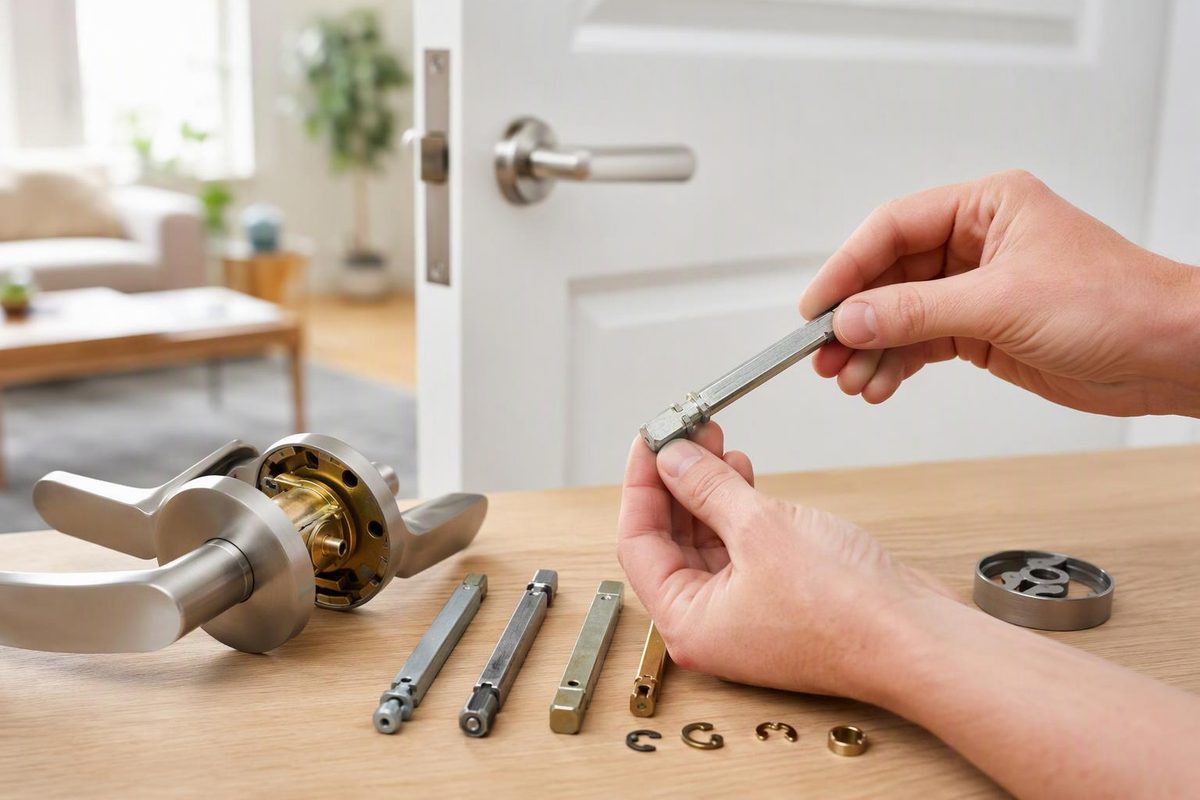
A door lever spindle is the shaft that transfers handle movement to the latch or lock. On a conventional square-spindle set, it passes through the lock’s follower—the rotating socket that operates the latch—and engages the handles. Pressing the lever turns the shaft and retracts the latch bolt. More Handles’ component guide explains that connection.
For a replacement, match the cross-section, length, retaining features and operating arrangement, not just a listing marked “door spindle.” An 8 mm square shaft is one documented example, not a universal fit: HOPPE’s New York handle-set specification specifies an 8 mm spindle for that particular set.
What to measure before ordering
Keep the door open while inspecting the hardware. Identify the handle and lock model before dismantling, and follow their removal instructions. Do not assume every lever pulls off after loosening a screw: HOPPE’s Quick-Fit system, for example, uses a dedicated release tool.
| Check | What to record |
|---|---|
| Square section | Measure between opposite flat faces, not diagonally across the corners. Use calipers if available; record the units. |
| Length | Measure the complete old shaft end to end. For separate sections, record each length and which side it came from. |
| Retaining features | Photograph slots, grooves, threaded ends, drilled holes, springs and other shaped features. Note where the handle screw engages. |
| Door and handles | Record door thickness and the handle/lock model. If changing handles too, the old spindle length alone does not establish fit. |
Spindles vary in both section and length, and different handles use different securing arrangements. More Handles’ guide documents plain, grooved, threaded and drilled versions.
Do not size a spindle by door thickness alone. The shaft must engage both handles sufficiently with the roses or backplates seated, without bottoming out and preventing them from seating. If the old spindle is missing—or was already the wrong length—use the manufacturer’s specified part or length range rather than copying an estimated dimension. Door Furniture Direct’s fitting guidance describes the disengagement and binding problems caused by incorrect length.
“Split spindle” can mean different things
A functional split spindle has separately rotating sections that work with a compatible lock mechanism so the inside and outside handles can operate independently. The spindle alone does not create that function; the lock needs the appropriate follower arrangement. Do not substitute a continuous bar simply because its width and overall length match. Door Furniture Direct distinguishes these arrangements.
A split-profile or slotted spindle may instead use its split as part of the handle fastening. HOPPE’s split-profile design expands when its special grub screw enters the spindle; its full-profile design uses a tension spring. Those names describe securing features, not proof of independent handle operation. See HOPPE’s spindle description.
Order by the identified system and part number wherever possible, especially when the shaft has springs or shaped ends.
Replace the spindle—or investigate another fault?
- The lever moves without driving the shaft: check its fastening and inspect the shaft’s engagement area. For applicable Emtek tubular entry sets, the manufacturer specifically recommends checking the setscrew that tightens the lever onto the spindle. Emtek FAQ
- The shaft turns but the latch does not retract consistently: investigate the follower or latch mechanism rather than assuming the handle is at fault. Door Furniture Direct’s inspection guidance
- The lever droops: a new spindle will not repair a failed return spring. Alignment or binding can also cause poor return. Door Furniture Direct’s troubleshooting guidance
Shorten a replacement only where its manufacturer permits, preserving the required engagement and fastening features. Do not make a functional split spindle by cutting a plain bar in two.
After assembly, test both levers and every locking or privacy function with the door open before closing it. Follow the model’s orientation and tightening instructions: Emtek’s CF 2.0 guide, for example, specifies cassette orientation, setscrew tightening and a privacy-function check.
For fire doors, required exit doors or electrified hardware, use the complete assembly’s approved instructions and verify applicable local requirements; a dimensionally matching shaft is not enough.