
Check Your Door and Household Before Buying Sense Pro
Measure door thickness, bores, backset, strike, and clearance, then check whether Sense Pro’s keyless, Apple-first access suits your household.
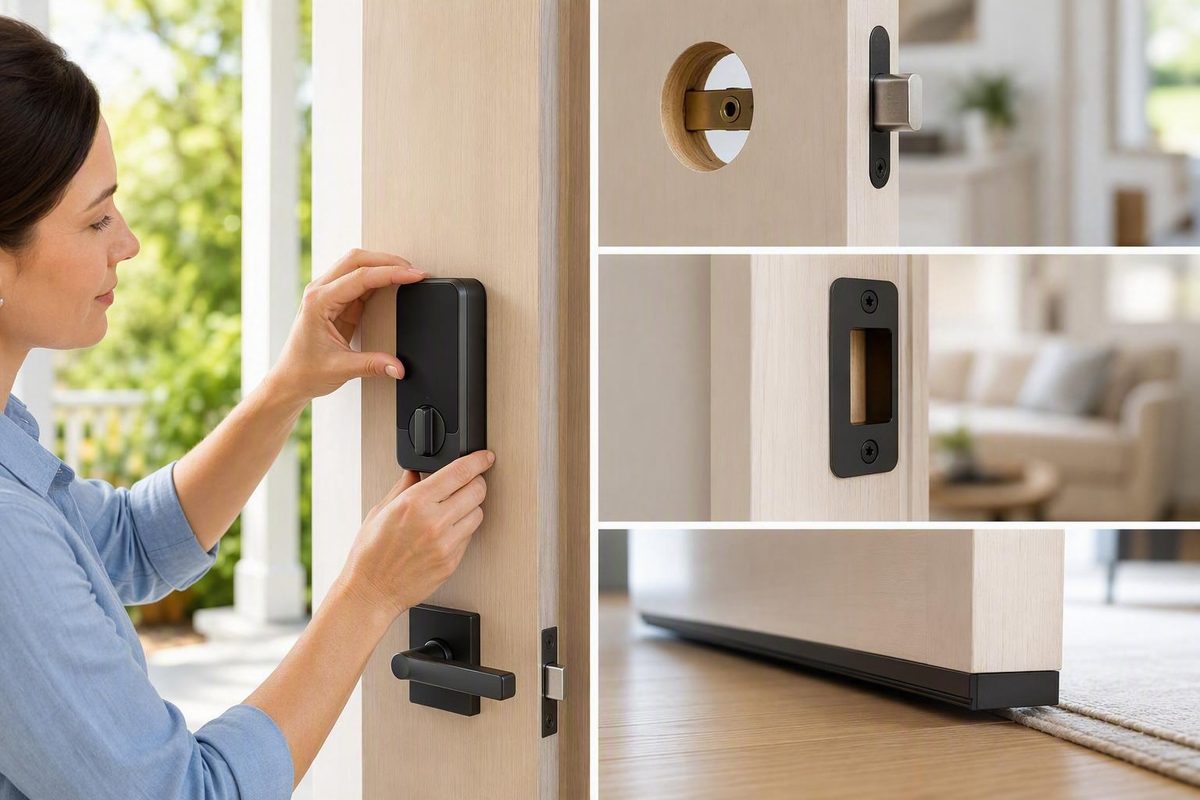
The Schlage Sense Pro fits most standard US doors prepared for a separate bored deadbolt, provided the dimensions, strike alignment, and housing clearance match. Do not buy it yet if your door is 2 inches thick, has a 2-1/8-inch cross-bore, uses mortise or interconnected hardware, or must retain keyed entry. Android-only households should also wait for the promised Aliro update or compare the Encode Plus: hands-free UWB unlocking works with compatible iPhones and Apple Watches at launch, and the Sense Pro has no exterior key cylinder.
Enter your door measurements and each household member’s phone; the result separates mechanical fit from access compatibility.
Choose the closest measured condition. “Verify” means the published evidence does not establish a direct fit; it does not mean an adapter is available.
| Check | Direct-Fit Value | Exception |
|---|---|---|
| Door | Separate bored deadbolt | Other systems need assessment |
| Thickness | 1-3/8–1-3/4 in. | Up to 2 in. appears only on support page |
| Backset | 2-3/8 or 2-3/4 in. | Other values not listed |
| Cross-bore | 1-1/2 or 2 in. | 2-1/8 in. not established |
| Edge bore | 1 in. | Other values not listed |
| Faceplate | 1 × 2-3/4 in. | Recess and corners still matter |
| Strike | 1-1/8 × 2-3/4 in. | Must clear 1-in. throw |
| Interior housing | ~3 × 5.5 × 2.5 in. | Check handle movement |
| Exterior housing | ~2.75 × 4 × 0.75 in. | Must sit flat |
| Physical keyway | None | Retain another keyed option if needed |
| Hands-free at launch | Compatible iPhone / Apple Watch | Android awaits promised Aliro update |
Door: Direct-fit dimensions selected, but confirm the current model template.
Household: Mixed Apple and Android household; Android hands-free entry is not available at launch.
- Wait for the promised Aliro update if Android hands-free entry is essential.
- Compare Encode Plus if buying now and hands-free UWB is not required.
Sources: Schlage Sense Pro door-preparation support, Schlage BE889WBFFF product specifications, Schlage product overview, SecurityInfoWatch launch information, and AppleInsider’s prepared-door installation review. Approximate housing dimensions are marked ~; unavailable measurements are shown as —.
Published Dimensions Define a Direct-Fit Candidate
The Sense Pro is a standalone smart deadbolt, not a replacement for a knob, lever, mortise case, or multipoint mechanism. A separate lower handle can remain if the interior and exterior assemblies clear it. Schlage identifies it as a standalone smart deadbolt, sold separately as model BE889WBFFF as well as in configurations shown with lower entry hardware.
Schlage’s support information lists these door-preparation dimensions:
| Fit Item | Published Requirement | Fit Decision |
|---|---|---|
| Door thickness | 1-3/8 to 2 in. | Conflict above 1-3/4 in. |
| Backset | 2-3/8 or 2-3/4 in. | Must match |
| Cross-bore | 1-1/2 or 2 in. | 2-1/8 in. needs verification |
| Edge bore | 1 in. | Must match |
| Latch faceplate | 1 × 2-3/4 in. | Check recess and corners |
| Strike plate | 1-1/8 × 2-3/4 in. | Check opening alignment |
| Deadbolt throw | 1 in. | Pocket must remain clear |
These figures come from Schlage’s Sense Pro door-preparation requirements. A door matching all listed dimensions is a direct-fit candidate, not a guaranteed fit. Damaged holes, a binding bolt, incompatible trim, or inadequate clearance can still prevent a sound installation.
Official Sources Conflict on Maximum Door Thickness
Schlage’s support page says the Sense Pro accommodates doors through 2 inches thick. The official BE889WBFFF specifications instead list a range of 1-3/8 to 1-3/4 inches.
A door from 1-3/8 through 1-3/4 inches falls within both published ranges. A 2-inch door belongs in the verify-first category. Before ordering, confirm through the current BE889WBFFF instructions or Schlage support whether that thickness requires different fasteners, a thick-door kit, or another model-specific provision. The available material does not establish the answer.
The product page also lists approximate exterior dimensions of 2.75 by 4 by 0.75 inches and interior dimensions of 3 by 5.5 by 2.5 inches. Those dimensions are useful for an initial clearance outline, but they do not show mounting points, battery-cover movement, or every contour of the housing.
A 2-1/8-Inch Cross-Bore Also Needs Confirmation
The model-specific support page lists 1-1/2-inch and 2-inch cross-bores. It does not list the 2-1/8-inch bore commonly encountered in residential doors.
Do not round a measured 2-1/8-inch opening down to 2 inches. The extra 1/8 inch can affect how a mounting plate centers, clamps, and covers the opening. Current evidence does not establish an approved adapter for this condition, so classify it as verify first until the current BE889WBFFF instructions expressly address it.
Compatibility cannot be inferred from an older Sense lock, another Schlage model, or a generic smart-lock installation. Mounting plates, trim coverage, cable routing, and accepted preparation can differ by model.
Separate Bored Deadbolts Are the Intended Starting Point
A conventional bored-deadbolt preparation normally has a round opening through the door faces, a smaller bore entering from the edge, a bolt in that edge bore, and a corresponding strike and pocket in the frame. A knob or lever below operates separately from the deadbolt.
A documented installation involved removing an existing deadbolt, inserting the supplied bolt into the prepared edge, mounting the exterior and interior components, connecting the internal cables, and installing the batteries. That AppleInsider Sense Pro review demonstrates a straightforward retrofit on a suitable prepared door, not universal compatibility.
Mortise hardware is materially different. It places a rectangular lock case in a deep pocket cut into the door edge, often combining the latch, deadbolt, handles, and cylinder. See What Is a Mortise Lock Set? for the preparation differences. Replacing that system with a bored smart deadbolt is a conversion project rather than a lock swap.
Interconnected locks, multipoint systems, sliding-door locks, historic hardware, narrow stiles, custom metal doors, and heavily repaired openings also require individual assessment. The available Sense Pro documentation does not establish a direct conversion or approved adapter for those configurations.
Five Measurements Establish the Basic Door Fit
Measure the Door Thickness at the Slab Edge
Measure from the flat interior face to the flat exterior face across the exposed door edge. Exclude weatherstripping, lock trim, decorative molding, and raised panels that do not represent the slab itself.
Record the actual result. From 1-3/8 through 1-3/4 inches is within both published ranges. Above 1-3/4 through 2 inches requires confirmation because of the official-source conflict. An irregular, layered, or unusually thin slab needs further assessment.
Measure Backset to the Bore Center
Backset is the distance from the door edge to the center of the large cross-bore. Start at the door edge rather than the outside edge of the latch faceplate, then measure straight to the bore’s centerline.
The Sense Pro bolt adjusts to 2-3/8 or 2-3/4 inches. It is not intended for an arbitrary distance between those positions. Remove trim before measuring if the existing assembly conceals the center.
Measure Both Bores Without Rounding
Measure the cross-bore across the widest part of the opening. Note whether it is circular, centered, cracked, enlarged, filled, or formed from overlapping holes. A listed diameter can still be unsuitable if the surrounding material cannot support the mounting assembly.
The edge bore is the smaller horizontal opening from the door edge to the cross-bore. Its published diameter is 1 inch. Confirm that it meets the cross-bore cleanly and that the bolt can sit in the proper orientation.
Compare the Faceplate and Recess
The listed latch faceplate is 1 by 2-3/4 inches. Record its height, width, recess depth, corner shape, screw positions, and the condition of the surrounding material.
Matching height and width do not establish that rounded corners, square corners, recess depth, or old screw holes will suit the supplied hardware. A different recess may be adjustable, but confirm the required preparation before removing wood or enlarging holes.
Check the Strike and One-Inch Bolt Throw
The listed strike measures 1-1/8 by 2-3/4 inches, and the deadbolt throw is 1 inch. Measure the frame pocket rather than judging it by appearance. It must be deep and correctly positioned enough for the bolt to extend fully without scraping or bottoming out.
Operate the existing bolt with the door open and closed. Binding in both positions points toward the bolt, lock, or bore alignment. Free movement while open but binding while closed points toward the strike, door position, hinges, weatherstripping pressure, or seasonal movement.
A deadbolt that works only while the door is lifted, pushed, or pulled is not ready for motorized operation. Correct the alignment problem before evaluating the smart features.
Housing Clearance Can Defeat Otherwise Matching Measurements
Outline the approximate 3-by-5.5-inch interior housing around the deadbolt centerline with removable tape or a paper template. Check the lower lever or knob, a handleset escutcheon, casing, glass trim, shutters, blinds, reinforcement plates, chains, and any second lock.
Rotate a lever through its complete travel. A lever can clear the housing while stationary but strike it while being operated. Leave enough finger space to use both controls without contacting the lock.
On the exterior, outline the approximate 2.75-by-4-inch assembly. It must sit flat rather than bridge a raised panel, groove, narrow stile, damaged area, or remnants of an oversized escutcheon. A storm-door handle or frame can also conflict even when the primary door is open.
These outlines are screening checks. Use the current model template for the final mounting decision because overall dimensions do not reveal every installation clearance.
The Least Certain Item Controls the Fit Verdict
A direct-fit candidate has a separate bored deadbolt, confirmed door thickness, one of the two listed backsets, a listed cross-bore, a 1-inch edge bore, compatible edge preparation, unobstructed bolt travel, sound material, and adequate clearance on both sides.
A 1-3/4-inch door with a 2-3/8-inch backset, a listed cross-bore, a 1-inch edge bore, compatible faceplate recess, clear frame pocket, and unobstructed housing space is a plausible straightforward retrofit. It is not a guarantee until the supplied hardware and current instructions are checked.
Use a verify-or-adjust result for a 2-inch slab, 2-1/8-inch cross-bore, different faceplate recess, shallow pocket, misaligned strike, enlarged opening, concealed damage, or close housing clearance. Identify the mismatch before drilling, filling, or chiseling.
Mortise, interconnected, multipoint, sliding, historic, narrow-stile, custom metal, and structurally uncertain doors warrant professional assessment. New boring can encounter glass, reinforcement, wiring, internal rods, or other hardware that is not visible from the faces.
The Keyless Exterior Changes Household Compatibility
The Sense Pro has no physical keyway. Replacing a keyed deadbolt therefore removes conventional key access at that opening. Electronic access includes keypad codes, Apple home key, and supported Schlage Home app control; the product announcement summarizes these access features.
At launch, hands-free UWB unlocking is for compatible iPhones and Apple Watches. Android hands-free support depends on a promised Aliro update. An Apple-device household can use the headline hands-free feature now, while an Android-only household buying specifically for passive UWB entry should wait.
An Android-only household that needs a lock immediately can compare the Schlage Encode Plus, particularly if hands-free UWB is not the deciding feature. Encode Plus is a different product family, so do not use its fit specifications to resolve a Sense Pro installation question.
Households should also decide whether keypad entry is acceptable for people without compatible phones, who will manage app access, and whether another entrance will retain a keyed lock. Mechanical compatibility does not resolve those access decisions.
The Sense Pro shipped on June 29, 2026, at $399 as Schlage’s first UWB hands-free, Matter-over-Thread deadbolt. The timing and price make the platform question consequential: Android buyers would be paying for hardware whose promised hands-free path was not active for them at launch.
Installation Is Short Only on a Correctly Prepared Door
On a compatible pre-drilled door, installation consists of removing the existing deadbolt, setting the supplied bolt to the correct backset, fastening it in the door edge, mounting the exterior and interior components, routing and connecting the cables, and installing four included AA batteries. Household hardwiring is not required.
The AppleInsider reviewer reported using a Phillips screwdriver and completing installation in about 5 to 10 minutes. Those are one reviewer’s experience on a suitable prepared door, not a promised tool list or installation time.
A mismatched faceplate, damaged screw holes, offset bore, shallow pocket, poor alignment, or strike that needs repositioning can make the job substantially different. Follow the supplied BE889WBFFF instructions for bolt orientation, cable routing, fastening, setup, and calibration.
Test the thumbturn and powered bolt repeatedly while the door remains open. Close the door only after the bolt completes its full travel without rubbing. Then confirm that it enters the frame pocket fully without requiring pressure on the door.
A 2-Inch Door Remains a Verify-First Case
Schlage’s support page allows 2 inches, but the BE889WBFFF product page stops at 1-3/4 inches. Current model-specific confirmation is required before treating a 2-inch slab as compatible. The supplied evidence does not say whether different fasteners or a thick-door provision are available.
A Lower Knob or Lever Can Usually Stay
A separate lower knob or lever does not inherently require replacement because the Sense Pro is sold as a standalone deadbolt. It must clear the interior housing through its full operating range. Shared plates, linked mechanisms, and interconnected trim are nonstandard configurations requiring separate assessment.
Battery Failure Does Not Restore Key Access
Because the exterior has no cylinder, a conventional key cannot operate the Sense Pro after battery failure. The AppleInsider reviewer reports an exterior USB-C connection for temporary emergency power, but the supplied first-party material does not independently establish the procedure. Verify the required power source and steps in the current user guide rather than relying on the review alone.
The purchase is therefore a two-part decision. The door must match the confirmed BE889WBFFF preparation, and the household must accept keyless entry plus Apple-only hands-free operation at launch. If either side fails, the Sense Pro is not the right immediate replacement.