
A Cylinder Door Lock Is Not One Replacement Type
Identify a cylindrical lockset or removable cylinder, then match its bore, backset, door thickness, function and cylinder format.
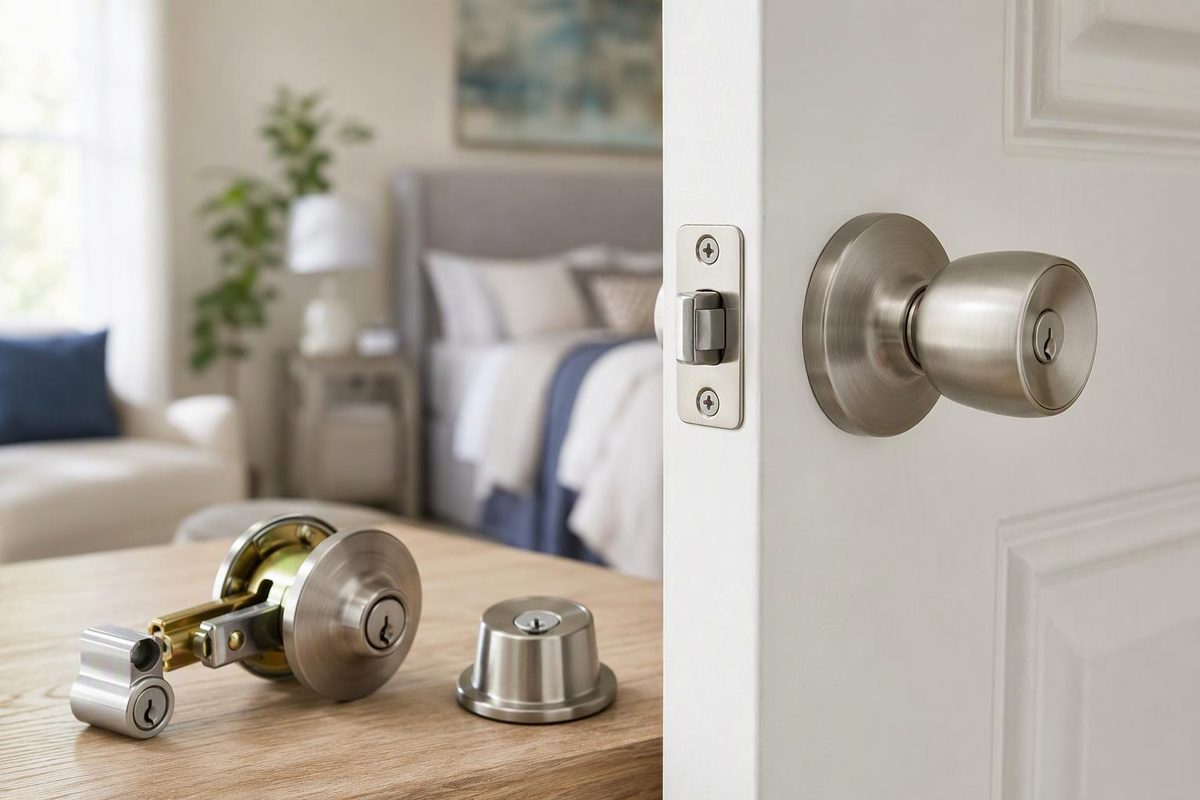
“Cylinder door lock” can mean either a cylindrical (bored) lockset or the smaller key cylinder inside a lock. Establish which part you have before measuring or ordering. A matching keyway or similar-looking lever does not establish compatibility.
A cylindrical lockset passes through a large bore in the door face and a smaller bore in the door edge. The cylinder is only the component that accepts the key and operates the locking mechanism. Cylinders also appear in mortise locks, deadbolts, exit-device trim and other hardware.
Identify the hardware first
| What you see | Likely hardware | What is normally replaced |
|---|---|---|
| Knob or lever on each face; round rose; latch in door edge | Cylindrical or bored lockset | Complete lockset, or a model-specific key-in-knob/key-in-lever cylinder |
| Rectangular lock case recessed into the door edge | Mortise lock | Threaded mortise cylinder, trim or complete mortise-lock components |
| Round cylinder mounted through the door, usually with a long flat tailpiece behind it | Rim cylinder operating surface-mounted hardware or exit trim | Rim cylinder matched to the mounting and tailpiece |
| Figure-eight removable core in a lever or housing | Small-format interchangeable core (SFIC) | Core of the correct format, removed with its control key |
Falcon defines a cylindrical or bored lock as one installed through a large hole in the door face and a smaller cross-bore in the edge. Its catalog treats conventional cylinders and small-format interchangeable cores as different cylinder options within those locks (Falcon lock catalog).
If the door edge shows a deep rectangular case, start with the mortise lock identification guide instead. Do not order a cylindrical lockset merely because the visible trim is round.
Measurements for a complete cylindrical lockset
Remove the existing trim only after keeping the door open and arranging another way to secure the opening. Record these dimensions in inches and millimeters where possible:
- Door thickness: Measure the slab itself, excluding applied trim.
- Cross-bore diameter: Measure the large hole through the door face.
- Backset: Measure horizontally from the door edge to the center of the cross-bore. Use the door edge as the reference, not a projecting part of the latch faceplate.
- Edge-bore diameter: Measure the hole carrying the latch.
- Latch faceplate: Record height, width, corner shape and screw spacing. Note a round drive-in collar instead of assuming there is a faceplate.
- Strike: Record its height, width, lip shape, screw spacing and latch opening. Also check whether the latch enters it without lifting or pushing the door.
- Door handing: Record which side is outside, whether the door swings in or out, and which edge carries the hinges. Many cylindrical locks are reversible, but not every trim or function is.
Common dimensions are useful clues, not a promise of fit. Allegion’s description of an ANSI 161 preparation specifies a 2-1/8 in. face bore, 1-1/8 × 2-1/4 in. edge preparation and generally a 2-3/4 in. backset (Allegion 161 door-prep note). By contrast, Kwikset specifies one current Tustin lever for a 2-1/8 in. face bore, 1 in. edge bore, 2-3/8 or 2-3/4 in. backset and 1-3/8 to 1-3/4 in. door thickness (Kwikset Tustin specifications). Verify the exact model’s drawing rather than treating either example as universal.
If replacing only the key cylinder
Record the lock manufacturer, series and function before dismantling it. Then match all applicable details:
- cylinder format: conventional fixed cylinder, large-format interchangeable core or small-format interchangeable core;
- body style: key-in-knob/key-in-lever, mortise or rim;
- body or catalog length;
- keyway and pin count;
- cam or tailpiece shape, length and orientation;
- retaining method and cylinder housing;
- collar or spacer dimensions;
- exposed finish.
These are functional dimensions. Yale’s cylinder manual lists mortise cylinders in multiple lengths and specifies different cams and collars for different applications (Yale cylinders and keying manual). Falcon likewise lists different tailpieces by lock series, function and cylinder format (Falcon cylinder catalog). A key entering the plug therefore does not prove that the replacement cylinder will operate or be retained by the lock. For a brand-specific example, see the Schlage cylinder replacement checks.
An interchangeable core uses a control key to withdraw the core from a compatible housing. Yale notes that this permits core replacement or rekeying without removing the lock hardware, but the core format and key system still have to match (Yale cylinders and keying manual).
Match the function before the finish
Describe what each side must do, not merely “keyed” or “locking.” For example:
- Entry/office: Outside can be locked; inside operation is generally intended to permit exit.
- Storeroom: Outside stays locked and is operated by key; inside remains operable.
- Classroom: Key controls the outside lever; inside remains operable.
- Passage: No locking function.
- Privacy: Inside button or turn with an outside emergency release, not normally a keyed security cylinder.
Commercial catalogs contain many additional functions with similar-looking trim. Sargent’s current 10X cylindrical line lists fixed and interchangeable cylinder formats, backsets from 2-3/8 to 5 in., a 1-3/8 to 2 in. door-thickness range and numerous mechanical functions (Sargent 10X specifications). Order by the manufacturer’s function description and model, not by appearance.
For a straightforward replacement, the existing hardware family, preparation, dimensions, latch position, strike alignment and required function should all match the new product’s documentation. If the existing backset or bores fall outside the new lock’s supported dimensions, the job requires door modification rather than a drop-in hardware swap. On a fire-rated, egress, accessible or electrified opening, verify the complete assembly, listing, manufacturer instructions and applicable local requirements before changing any component.