
Choose a Heavy-Duty Door Closer by Grade, Power and Fit
Choose a heavy-duty door closer by ANSI/BHMA grade, spring size, arm construction and opening force—not door weight or appearance alone.
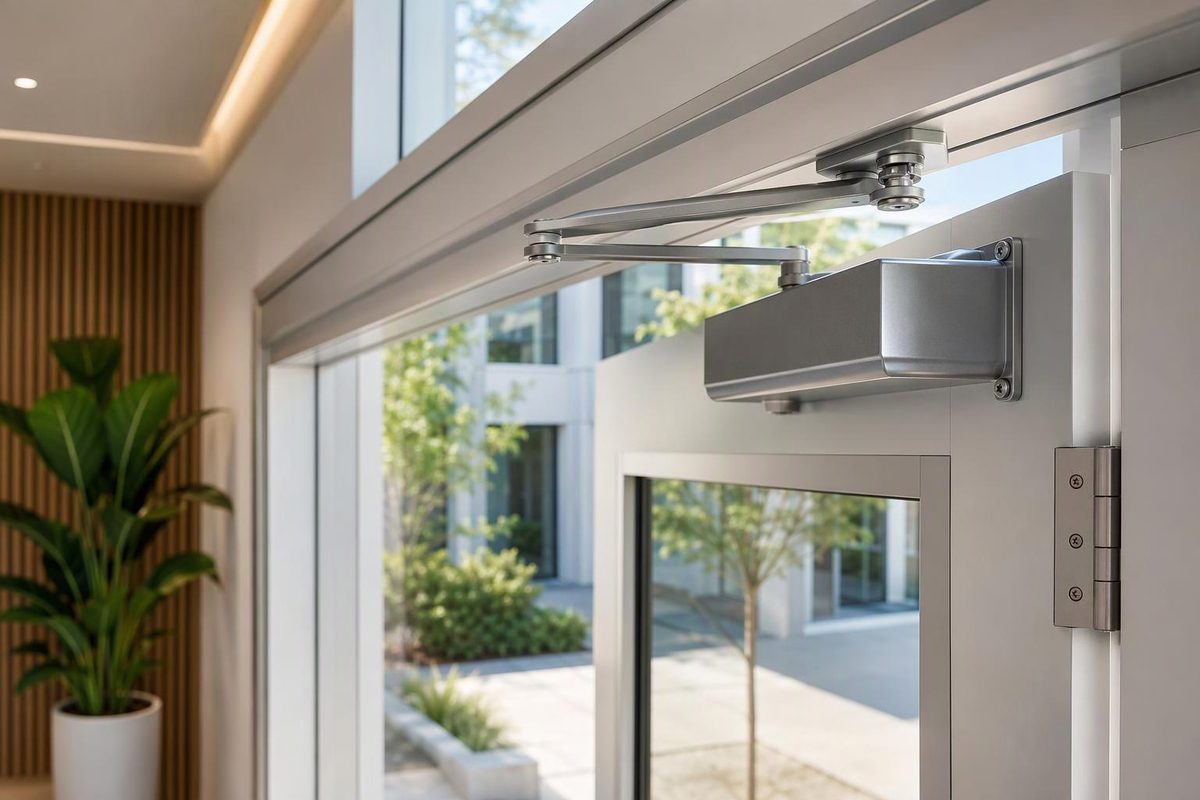
For a busy door, look for documented ANSI/BHMA A156.4 Grade 1 performance, then match spring power and the installation template to the opening. “Heavy duty” alone does not tell you whether a closer has enough closing power, fits the existing holes, or keeps the door easy enough to open.
Before ordering, record the existing closer’s manufacturer and model, door-leaf width, mounting arrangement and screw-hole centers. For identification and a full replacement-measurement checklist, see identifying an overhead door closer.
Grade and spring size answer different questions
| Specification | What it tells you | What it does not establish |
|---|---|---|
| ANSI/BHMA A156.4 Grade 1 | Performance under the standard’s tests, including endurance | The correct spring setting for your door |
| Spring size, such as adjustable 1–6 | Available closing-power range | Durability grade or mounting compatibility |
| Manufacturer’s interior/exterior width chart | A starting power selection for the stated application | Reliable operation under every wind or pressure condition |
| Mounting template and arm designation | Where the body and arm attach and the intended opening geometry | Suitability for a fire-rated or accessible assembly by dimensions alone |
BHMA’s summary of A156.4-2024 says Grade 1 closers must pass two million opening-and-closing cycles on a test door of specified weight. The standard also evaluates operating features, closing force and finish. That is test performance—not a promise of two million trouble-free cycles on any installed door. Source: BHMA hardware highlights.
Spring size describes power, not endurance. LCN identifies door width as the main sizing consideration; its charts assume normal conditions. Exceptional height, weight, construction, drafts or air-pressure differences can change the power requirement. Do not choose solely from a seller’s maximum door-weight claim. Source: LCN general information catalog, door dimensions.
When heavy-duty construction is worthwhile
Heavy-duty hardware is worth considering for a frequently used shared entrance, an exterior door, or a door exposed to rough use. LCN specifically recommends heavy-duty closers for high-frequency openings, schools and public buildings with heavy or abusive usage, exterior doors, and doors affected by drafts, wind or pressure differences. Source: LCN selection guidance.
Check the arm as well as the body. LCN describes forged-steel main arms as a durable alternative to stamped-steel arms and offers extra-duty arm options. Compare the specified arm construction and function rather than assuming every arm sold with a heavy-duty closer is equivalent. Source: LCN arm options and materials.
A lightly used interior door does not automatically need maximum spring power. Nor does a door that fails to latch automatically need a larger closer: inspect for rubbing, loose hinges and latch/strike misalignment first. LCN requires free door movement and proper latch operation before closer installation. Source: LCN installation checks.
A documented example—not a universal replacement
The LCN 4040XP illustrates how these specifications differ. As listed in October 2026, it has A156.4 Grade 1 certification, adjustable spring sizes 1–6, a non-handed design, and regular-arm, top-jamb and parallel-arm mounting options. Its listed width limits are 60 inches for interior doors and 48 inches for exterior doors. Those limits do not replace the application chart, arm selection or template check. Source: LCN 4040XP specifications.
For any replacement, compare body and arm-bracket hole centers with the template for the exact arm and mounting arrangement. Also check top-rail and frame space, reveal depth, opening angle and required fasteners. LCN notes that narrow top rails may require plates and that standard locations can interfere with other hardware. A matching body-hole pattern alone is not a complete fit check. Source: LCN mechanical considerations.
Check opening force and closing control
The spring supplies closing power; hydraulic circuits control closing speed. Backcheck cushions the opening swing. Backcheck is not a substitute for a door stop: LCN calls for a mechanical stop where needed, which may be separate or built into an appropriate closer arm. Source: LCN opening-angle guidance.
For U.S. doors required to meet the ADA Standards:
- A closer must take at least 5 seconds to move from 90° open to 12° from the latch—not simply five seconds to close completely.
- Non-fire-rated interior hinged doors have a maximum continuous opening force of 5 lbf (22.2 N), excluding latch retraction and the initial force needed to overcome door inertia.
- The ADA Standards do not specify a maximum opening force for exterior hinged doors. Fire doors use the minimum opening force allowed by the appropriate administrative authority; local requirements still need checking.
These are requirements for the installed opening, not something a “heavy-duty” or “ADA” product label guarantees. Sources: ADA §§404.2.8–404.2.9 and Access Board opening-force guidance.
For a fire door, verify the complete assembly’s instructions, closer listing and permitted arm function before replacing or drilling. For example, LCN lists the 4040XP for self-closing doors without hold-open; that is not blanket approval for every arm option. Source: LCN 4040XP listing. After installation, check reliable closing and latching as well as opening force—maximum spring power is not the goal.