
Swap Nest x Yale Without Drilling New Door Holes
Compare bore, backset, door thickness, strike alignment, Google Home support, and Nest Connect changes before replacing the lock on the same door.
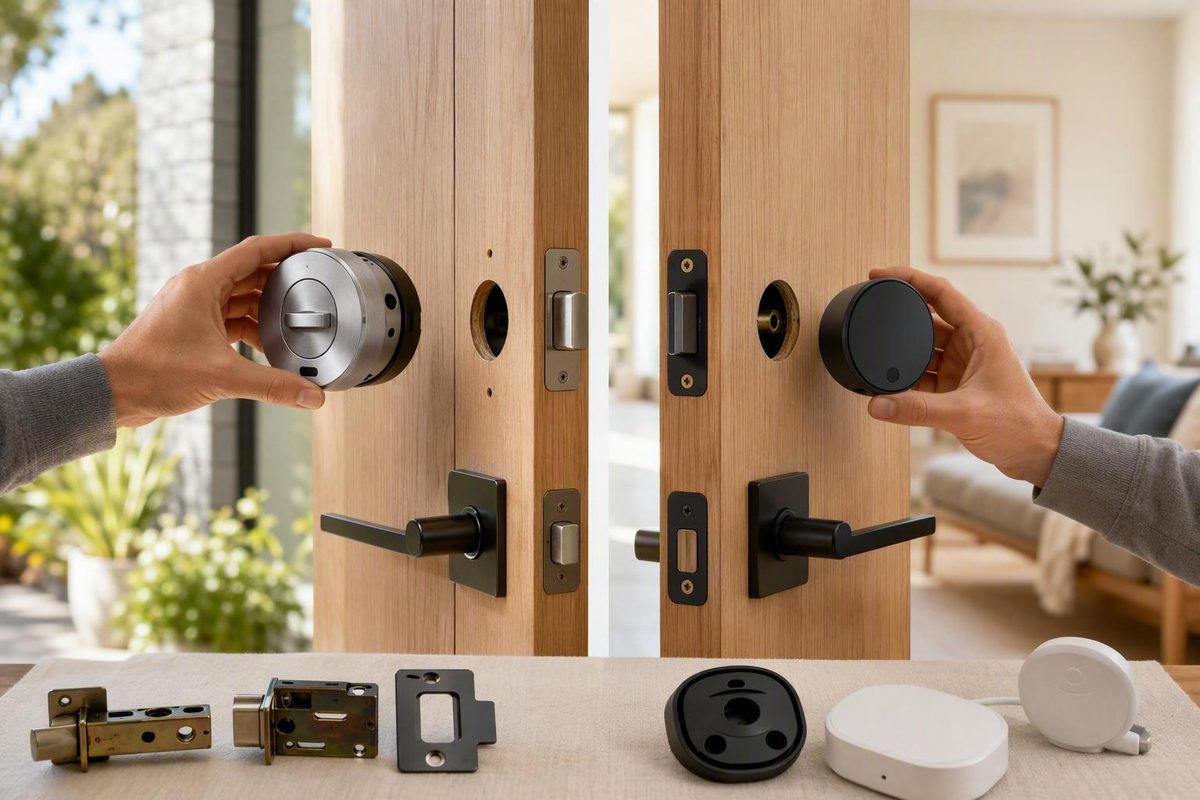
Yes—the Yale Smart Lock with Matter should fit the same door without new holes when the existing Nest x Yale installation has the standard 2-1/8-inch face bore, 1-inch edge bore, and either a 2-3/8- or 2-3/4-inch backset. Confirm the door is 1-3/8 to 2-1/4 inches thick. The replacement does not use Nest Connect and adds an exterior keyed cylinder, while existing Nest x Yale locks continue to receive Google Home app support.
This is not a guarantee that every swap requires only a screwdriver. Yale’s published dimensions do not establish identical mounting plates, through-bolt positions, strikes, screw locations, or trim footprints. A nonstandard installation, damaged bore, misaligned strike, or exposed paint line can still require repair.
Enter the preparation visible under your current lock; the matcher identifies a direct fit, adapter installation, strike adjustment, or re-boring.
Use measurements from the exposed door preparation, not the dimensions of the keypad or interior trim.
No new door holes indicated by these default measurements.
The 2-1/8-inch face bore, 1-inch edge bore, 2-3/8-inch backset, and 1-3/4-inch door thickness are within the Yale Matter specifications. Trim coverage and model-specific mounting geometry still require comparison.
Requirement Reference
| Check | Direct Or Supported Fit | If It Does Not Match |
|---|---|---|
| Door system | Standard bored deadbolt | Mortise, multipoint, and interconnected systems need separate assessment |
| Face bore | 2-1/8 in.; 1-1/2 in. with included adapter | Other sizes may require re-boring or another lock |
| Edge bore | 1 in. | Wrong size or alignment requires correction |
| Backset | 2-3/8 or 2-3/4 in. | Unsupported center position can require re-boring |
| Door thickness | 1-3/8 to 2-1/4 in. | Outside the published range is not an as-is fit |
| Strike operation | Full travel without force | Adjust alignment or recess before calibration |
| Trim coverage | Must be checked separately | Plan finish repair if marks remain exposed |
How To Read The Result
A dimensional pass does not establish identical through-bolt positions, mounting plates, screw locations, strikes, or escutcheon coverage.
Source: Yale published specifications for Nest x Yale and Yale Smart Lock with Matter; Google installation guidance. Unknown dimensions are shown as — in the result.
The Principal Door Dimensions Match
Yale’s specifications for the Yale Smart Lock with Matter and the Nest x Yale Lock list the same principal preparation for a standard bored deadbolt.
| Specification | Nest x Yale | Yale Matter | Replacement Effect |
|---|---|---|---|
| Face bore | 2-1/8 in. | 2-1/8 in. | Direct nominal match |
| Edge bore | 1 in. | 1 in. | Direct nominal match |
| Backset | 2-3/8 or 2-3/4 in. | 2-3/8 or 2-3/4 in. | Same center positions |
| Door thickness | Conflicting minimum; maximum 2-1/4 in. | 1-3/8 to 2-1/4 in. | Measure the slab |
| Grade | ANSI/BHMA Grade 2 | ANSI/BHMA Grade 2 | Same grade, not same parts |
The Matter model also supports a 1-1/2-inch face bore with an included adapter. That feature normally is not needed for a door prepared to the published Nest x Yale specification, which calls for a 2-1/8-inch bore. It provides a supported route if removing the old trim reveals a smaller opening.
Nest x Yale documentation conflicts on minimum door thickness. One specification gives 1-3/8 inch, while another describes compatible standard doors as starting at 1-3/4 inches; both give a 2-1/4-inch maximum. The Matter lock’s stated range is 1-3/8 to 2-1/4 inches, so measure the door rather than treating the old installation as proof.
Both locks accommodate common door handing, and both carry the same listed Grade 2 classification. Neither fact proves that their mounting plates, fasteners, latches, or trim are interchangeable.
Google Now Points Buyers To The Matter Lock
On July 2, 2026, the Google Store sold out of and removed its Nest x Yale listing, redirecting the former product address to the $189.99 Yale Smart Lock with Matter. Purchases are completed through Yale rather than Google, according to 9to5Google and Android Authority.
That redirect establishes which product Google is presenting as the successor. It is not a mechanical interchangeability statement or an installation drawing.
The same reporting confirms that existing Nest x Yale locks retain Google Home app support. No support end date is supplied in the available evidence, so an installed lock does not need to be removed merely because Google stopped selling it. Keeping the old lock operational also gives you time to verify the new door preparation and connected-home requirements before dismantling working hardware.
Confirm That The Door Uses A Bored Deadbolt
The dimensional match applies to a conventional single-bore deadbolt preparation: a large round hole through the door face, a 1-inch edge bore for the latch, and a separate strike and bolt recess in the frame.
Do not use the shared bore dimensions to evaluate a door with:
- A long faceplate extending along much of the door edge
- Multiple hooks, rollers, or bolts moving together
- A large rectangular lock case recessed into the door
- Interconnected handle and deadbolt hardware
- A narrow stile without a conventional round deadbolt bore
- Sliding or substantially glazed construction requiring specialized hardware
Yale’s Nest x Yale compatibility guidance excludes glass doors, sliding doors, mortise locks, and multipoint locks from the old model’s standard applications. A mortise lock has a working case in a deep rectangular pocket; a bored deadbolt occupies intersecting round holes. Changing between those formats generally requires filling and recutting rather than swapping smart-lock trim.
Wood, metal, and fiberglass doors can have a compatible bored preparation. An unprepared or unusually drilled metal door warrants professional assessment because correcting it is not the same operation as re-boring a wood slab.
Measure The Exposed Preparation Before Ordering
Remove batteries or follow the old lock’s shutdown procedure, keep the door open, and support both lock halves during removal. Photograph the exterior keypad, interior unit, latch faceplate, strike, frame gap, reinforcement plates, adapters, and surrounding finish before disturbing them.
Measure the slab itself, excluding weatherstripping, molding, and raised decorative panels.
| Measurement | How To Check | Yale Matter Requirement |
|---|---|---|
| Face bore | Across the large door hole | 2-1/8 in.; 1-1/2 in. with adapter |
| Edge bore | Across the edge hole | 1 in. |
| Backset | Edge to face-bore center | 2-3/8 or 2-3/4 in. |
| Door thickness | Across the bare slab | 1-3/8 to 2-1/4 in. |
Google’s Nest x Yale installation guidance also calls for checking thickness, backset, alignment, and the existing preparation.
Measure To The Bore Center
The exterior keypad is larger than the face bore and cannot be used to estimate the hole diameter. Measure the exposed opening after removing the trim.
For backset, measure from the actual door edge to the center of the face bore—not to the near side of the hole or from decorative trim. A reading between 2-3/8 and 2-3/4 inches may indicate a measuring error, but a genuinely unsupported center position requires correction rather than forcing the latch into place.
Inspect the 1-inch edge bore and its faceplate recess. A crooked bore, shallow mortise, crushed wood, or distorted metal can prevent a direct installation even when the nominal diameter is correct.
Test The Strike With The Door Open And Closed
Extend and retract the existing deadbolt with the door open. It should travel without scraping or binding. Close the door gently and repeat the test without lifting, pushing, or pulling the slab.
The bolt must enter the strike without rubbing its top, bottom, or sides. The recess behind the strike must also be deep enough for full extension. A correctly sized face bore does not fix a shallow recess, sagging door, loose hinge, or weatherstripping that holds the slab away from its proper position.
Record the measurements and operating condition before removing the only working lock. A useful record includes the face bore, edge bore, backset, door thickness, whether the bolt enters freely, and whether the recess permits full travel.
A Matching Bore Can Still Require Door Work
A direct installation is plausible when the face bore is 2-1/8 inches, the edge bore is 1 inch, the backset is exactly 2-3/8 or 2-3/4 inches, and the slab falls within the Matter lock’s thickness range. The exposed preparation must also be sound, unobstructed, and aligned with the frame strike.
A 1-1/2-inch face bore follows a different but documented route: use the adapter included with the Matter model, provided every other requirement is satisfied.
Minor strike or alignment work may be needed when the bolt rubs, the frame recess is too shallow, the strike is off center, hinges are loose, the door has sagged, or weatherstripping changes the closed position. Correct the door or strike instead of relying on the lock motor to force the bolt.
Re-boring or more substantial repair may be necessary when:
- The face-bore center has an unsupported backset
- The edge bore is not 1 inch
- The face bore matches neither supported installation method
- The face and edge bores do not align
- Old holes interfere with the new mounting system
- Prior repairs leave inadequate material for secure fastening
- A reinforcement plate conflicts with the specified hardware
Do not enlarge an opening simply because a part fails to slide into place. Verify the component, orientation, adjustable-latch position, and current installation template first. Incorrect drilling can remove material needed for a secure repair.
A locksmith or experienced door installer should assess warped, badly sagging, split, extensively repaired, mortised, multipoint, narrow-stile, or unusually interconnected doors.
Use The New Lock’s Latch, Strike, And Fasteners
The common preparation dimensions do not show that model-specific parts can be mixed. Unless the current Matter instructions expressly allow reuse, treat the latch, strike, mounting plate, through-bolts, machine screws, wood screws, tailpiece, spacers, adapters, and reinforcement pieces as specific to each lock.
Google’s instructions for Nest x Yale required replacing the existing strike with the supplied Nest x Yale strike because even a similar-looking strike could cause jamming. That instruction does not establish the Matter model’s procedure, but it shows why appearance alone is insufficient grounds for reusing deadbolt parts.
Retain the complete old assembly during the changeover. Compare the exposed preparation with the current Matter template, then install only the specified new parts. Test full bolt travel with the door open before testing it closed. Do not complete calibration or rely on connected control until the physical action is dependable.
If unexplained holes, split wood, compressed material, loose reinforcement, or distorted sheet metal appears, stop rather than tightening the new hardware over the defect. Reinstall the old lock or maintain another secure barrier if the replacement cannot be completed that day.
Trim Coverage Remains An Unknown
The available specifications do not provide a complete exterior-and-interior escutcheon comparison. A shared 2-1/8-inch bore therefore does not guarantee that the Matter lock will cover the Nest x Yale footprint.
Removing the old trim may expose unpainted material, fading, compressed finish, scratches, corrosion, old holes, sealant, or the corners of a differently shaped outline. Trace both old escutcheons with low-tack tape or paper and record their maximum height, width, and position relative to the bore center. Compare that outline with current drawings or the physical replacement before tightening it permanently.
Cosmetic touch-up does not mean the door is mechanically incompatible. It is a separate cost and appearance decision that the bore measurements cannot resolve.
The Smart-Home Change Is Not A Nest Connect Migration
Nest x Yale uses Nest Connect for its connected functions. The Yale Matter replacement instead requires compatible Matter-enabled hub and Thread border-router infrastructure for connected and remote operation. Nest Connect should not be treated as the Matter bridge or Thread border router for the new lock.
You can leave Nest Connect and the old lock operating while preparing the replacement. After installation, plan to add the new lock through the current Yale and Google Home process and recreate required users, codes, schedules, notifications, and automations unless current migration documentation explicitly provides a transfer method.
The hardware also changes the exterior entry method. Nest x Yale is a key-free touchscreen deadbolt. The Yale Smart Lock with Matter includes a physical-key cylinder. That provides another way to enter but changes the key-free appearance and operating model of the old lock.
Before retiring the Nest x Yale equipment, verify the new lock’s keypad, app, voice, remote, and physical-key access as applicable. Confirm that everyone who needs entry has a working method, and test the bolt with the door open and closed. Reset or remove the old equipment only after the replacement is physically and digitally dependable.