
Choose the Right Door Protection for the Damage You Actually Have
Use a clear panel for claws on the door face, an edge guard for localized wear, a pet barrier to prevent contact or a taller plate for cart impacts.
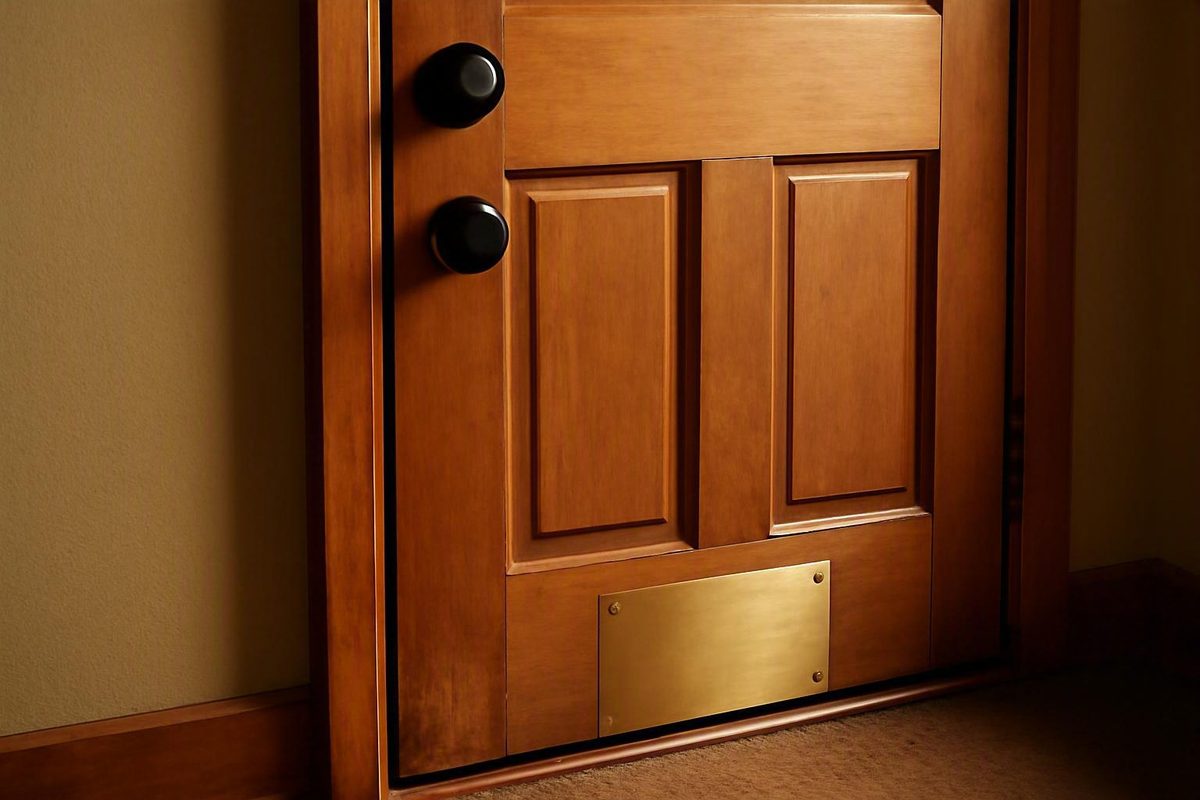
The most useful door kick plate alternatives are not necessarily different materials shaped like the same familiar plate. They are solutions matched to the damage: a clear panel for claws on the door face, an edge guard for localized wear, a barrier that keeps a pet away, or a taller commercial plate for cart impacts.
Start by identifying what touches the door, how high and wide that contact reaches, and whether it affects the face, edge, jamb, or weather stripping. Then choose the least invasive protector that covers the complete contact zone and is compatible with the actual door surface.
What Counts as an Alternative to a Door Kick Plate?
A conventional kick plate is a horizontal protective sheet installed near the bottom of a door. It covers an area commonly exposed to shoes, cleaning equipment, marks, dents, scuffs, and other low-level wear. Retail guidance identifies metal, vinyl, and plastic versions, along with screw, adhesive, and magnetic mounting methods. Koffler Sales describes the basic kick-plate format, materials, and attachment options.
That definition creates an important distinction:
- Kick-plate variants preserve the horizontal lower-door plate format but change its material, finish, size, or mounting method.
- True alternatives protect a different area, use another form of coverage, or prevent contact instead of absorbing it.
Adhesive and magnetic kick plates are therefore no-drill versions of a conventional kick plate—not fundamentally different types of protection. The same applies to aluminum, vinyl, decorative brass, or colored metal plates. Retail categories include screw-mounted, adhesive-mounted, magnetic, and custom plates in numerous finishes, showing that mounting and appearance can change without altering the underlying format. Van Dyke’s kick-plate category illustrates these variations.
True alternatives include:
- Rigid scratch panels: Clear acrylic, plastic, plexiglass, or similar panels placed over the actual scratch zone.
- Flexible guards: Silicone, vinyl, or other flexible coverings, including some cut-to-fit formats.
- Edge and jamb protection: Narrow guards for a door edge, frame, jamb, or weather strip.
- Localized lower-door protection: Smaller guards covering only the affected portion instead of spanning the door.
- Temporary coverings: Draped sheets, blankets, or replaceable decorative coverings for light-duty use.
- Access barriers: Pet gates or other obstacles that keep the source of damage away from the door.
- Specialized protection plates: Mop, armor, and stretcher plates positioned according to the height and source of commercial wear.
A plate may still be the right answer if the objection is drilling rather than appearance or coverage. Someone dealing with shoe scuffs across the lower door may need exactly the coverage a conventional plate provides, but with adhesive or magnetic mounting. By contrast, someone whose dog scratches well above the normal kick zone needs a different size and shape regardless of what the product is called.
The available evidence establishes that these categories exist and are marketed for particular uses. It does not establish which material lasts longest, removes most cleanly, survives weather best, or provides the greatest scratch or impact resistance. Product formats and intended uses are easier to verify than comparative performance.
Choose by Damage Type, Height, and Door Side
Begin with the damage rather than a preferred material. A protector works only where it overlaps the contact.
| Damage source | Contact location | Suitable category | Typical mounting choices | Principal limitation |
|---|---|---|---|---|
| Light shoe scuffs | Low on the push side | Small lower-door guard, clear panel, or short plate | Compatible adhesive, magnetic mounting on a suitable door, or screws | Protects only the covered area |
| Persistent pet claws | Door face at the observed scratch height | Rigid clear panel or flexible scratch guard | Adhesive, hook-and-loop, or product-specific fasteners | A standard short plate may not reach the highest marks |
| Claws on the door edge | Latch or hinge edge | Edge guard | Clip-on, adhesive, or mechanical attachment | Does not protect the broad door face |
| Scratching beside the door | Jamb, trim, or weather stripping | Jamb guard or localized barrier | Product-specific adhesive or mechanical attachment | Must be fitted without disrupting door operation |
| Cleaning or vacuum contact | Very low on the pull side | Mop plate | Commonly mechanical; product-specific alternatives may exist | Positioned for low cleaning contact, not higher impacts |
| Repeated carts or trucks | Broad lower-door area | Armor plate | Commonly mechanical | Large coverage may conflict with locks or other hardware |
| Stretchers or service equipment | Mid-height band on the push side | Stretcher plate | Commonly mechanical | Protects a specific band rather than the entire lower door |
| Occasional light scratching | Variable | Temporary sheet, blanket, or removable covering | Draped, hook-and-loop, or product-specific temporary attachment | Not established for persistent or heavy contact |
| Pet trying to reach the other side | Door, jamb, or nearby frame | Pet gate, access barrier, or possibly a dog door | Freestanding or mechanically installed, depending on the product | Changes access rather than reinforcing the surface |
Commercial terminology is particularly useful when contact occurs outside the normal residential kick zone. A mop plate addresses low pull-side cleaning wear, an armor plate covers a much larger lower area exposed to carts or rough use, and a stretcher plate creates a higher band for equipment contact.
For light shoe marks confined to one section, do not assume the protector must span the full width or rise far up the door. A short, localized guard may be sufficient. Smaller coverage also preserves more of the original finish and limits the area subjected to adhesive.
Persistent claw marks require a different approach. Measure to the top of the highest observed scratch—not merely to the animal’s paw height while standing—and cover the likely side-to-side movement. A nominal residential kick plate may end below the active scratch zone.
Location matters as much as height. A face-mounted panel cannot protect a latch edge, jamb, or weather strip. If damage wraps around the edge or appears beside the door, direct the protection there instead of adding a larger face panel.
Also distinguish scratching from impact. A thin sacrificial surface may be a reasonable format for claw marks or light scuffing, while broad cart contact calls for wider and taller coverage. That distinction does not prove that one material is stronger than another; it identifies the form and extent of protection the application requires.
Use this quick selector:
- Identify the source: Shoes, claws, vacuums, carts, stretchers, or another object.
- Mark the contact zone: Note the highest, lowest, leftmost, and rightmost marks.
- Identify the side and surface: Push side, pull side, edge, jamb, or weather stripping.
- Choose the smallest suitable format: Cover the complete likely contact zone without overlapping hardware unnecessarily.
- Choose the mounting method last: Match it to the door material, exposure, and required reversibility.
True Alternatives: Clear Panels, Flexible Guards, Edge Protection, and Barriers
If a visible full-width metal plate is undesirable, several alternatives preserve more of the door’s appearance or concentrate protection where it is needed.
Clear acrylic or plastic scratch panels provide rigid coverage while allowing the paint, grain, or color beneath to remain visible. Commercial listings include small precut acrylic panels, while general scratch-protection guidance describes clear plastic screens and cut-to-fit adhesive rolls. Transparency can make a panel less visually dominant than metal, although its edges, adhesive, and accumulated scratches may remain visible.
Silicone and vinyl guards provide flexible, nonmetal coverage. Marketplace listings include cuttable silicone guards alongside clear acrylic and self-adhesive metal protectors. Those listings confirm commercial availability at the time the page is viewed, but descriptions of durability, pet friendliness, scratch resistance, or exterior suitability remain seller claims rather than independent performance findings. Amazon’s category page shows examples of acrylic, silicone, adhesive, and metal formats.
A flexible guard may be useful when the scratch area is narrow or an exact factory size is unavailable. It is not automatically suitable for a deeply paneled door. The selected guard still needs to fit the intended mounting surface according to its instructions.
Edge guards and lower-door protectors make sense when damage is localized. A narrow edge protector can cover wear concentrated along the latch edge; a short lower-door guard can address a small area without visually dividing the whole door. Neither will help if the damage extends beyond its footprint.
Jamb and weather-strip protection is a separate problem. Dogs may scratch the frame or soft weather seal rather than the door face. Documented options include clear screens, localized guards, and vinyl lattice placed over an affected jamb or weather-strip area. Whatever format is selected, verify that the door still closes and latches as intended.
Wallpaper, sheets, and blankets should be treated as temporary or light-duty measures. Fabric can be draped over a door or attached temporarily, while peel-and-stick wallpaper can cover a frequently scratched area. These options may buy time or improve appearance after minor contact, but the available guidance does not establish them as protection against persistent or forceful scratching. wikiHow presents clear screens, fabric, wallpaper, barriers, dog doors, and vinyl-lattice jamb protection as separate options.
Pet gates and sturdy barriers work differently: they reduce or prevent access instead of absorbing damage. They can be more direct when the animal does not need to approach the door. Their usefulness depends on whether the barrier is appropriate for the space and consistently keeps the pet away.
A dog door may address the cause when scratching is an attempt to enter or leave. It is less relevant when scratching occurs for another reason, and it may not be acceptable for a rental or suitable for the door.
A useful permanence scale is:
- Temporary: Draped fabric or a movable access barrier.
- Removable or replaceable: Hook-and-loop-mounted guards, replaceable scratch screens, or some edge protectors.
- Adhesive: Panels and guards bonded directly to the finish.
- Mechanically fastened: Screw-mounted panels, plates, or guards.
“Removable” does not mean “risk-free.” Temporary adhesives can still mark a finish, and hook-and-loop strips need their own attachment method.
No-Drill Options and Their Trade-Offs
No-drill protection avoids screw holes, but it does not eliminate installation or removal risk.
| Method | Surface requirements | Reversibility | Positioning | Main uncertainties |
|---|---|---|---|---|
| Adhesive | Clean, dry, compatible, sufficiently flat surface | Variable; removal may be difficult | Often limited after first contact | Residue, finish lifting, fiber pull, edge lifting, weather exposure |
| Magnetic | Magnet-attracting surface with adequate flat contact | Usually easy to lift and reposition | Generally adjustable | Holding strength, stainless-steel compatibility, surface contours |
| Hook-and-loop | Compatible attachment for the strips | Guard may detach, but attached strips remain | Adjustable within the strip layout | Adhesive effects and suitability for repeated scratching |
| Draped fabric | A configuration that permits normal door operation | High | Easy to move | Light-duty protection and possible interference if poorly positioned |
| Access barrier | A suitable surrounding space | Often high for movable types | Independent of the door face | Whether it consistently prevents contact |
Adhesive mounting
Adhesive plates and guards avoid drilling. They generally require cleaning, complete drying, careful alignment, and firm pressure according to the selected product’s instructions.
The main trade-off is removal. An adhesive protector may be difficult to reposition once contact begins. Later removal can leave residue or lift paint, clear finish, or material from some fiberglass skins. Thin fiberglass and composite doors require particular caution because screws can also crack, crush, dimple, or loosen in the skin. Framewell’s commercial guidance describes risks associated with both adhesive and screw mounting on fiberglass doors.
If reversibility matters, test the proposed removable adhesive in a concealed area.
Magnetic mounting
A magnetic guard requires a surface that attracts a magnet. It will not attach magnetically to wood, fiberglass, aluminum, or another nonmagnetic surface. Some stainless-steel door faces may also provide weak or unreliable attraction.
Test the intended mounting area with a magnet before buying. Do not infer compatibility from a silver finish, a “metal door” description, or the material used elsewhere in the assembly.
A magnetic protector also needs an appropriate fit. Dry-fit the product and verify normal door operation before relying on it.
Hook-and-loop, fabric, and access barriers
Hook-and-loop attachment can make a guard replaceable, but the strips still have to adhere or fasten to the door. The evidence documents the method as an option; it does not establish it as a heavy-duty or long-term system.
Draped sheets and blankets offer more reversibility but should be treated as temporary, light-duty coverage. Position fabric so that the door can still close and latch normally.
Access barriers avoid attaching anything to the door. Their success depends on consistently preventing contact rather than on the strength of a protective surface.
When screws still make sense
It is not the default answer for every door. Screws leave permanent holes and may damage thin fiberglass or composite skins.
Follow the restrictions and instructions supplied for both the door and the protector. Do not assume that included fasteners are automatically appropriate for every door construction.
Match the Guard to the Door Material and Exposure
There is no universal mounting method for every door. Use a compatibility checklist before choosing a protector.
Painted wood or veneer
- Identify the coating or finish if possible.
- Check whether the adhesive manufacturer approves the product for that finish.
- Assume adhesive removal may leave residue or lift paint, clear coat, or veneer until compatibility is established.
- Remember that screws leave permanent holes.
- Avoid spanning deep panels unless the protector is designed for that profile.
Fiberglass and composite skins
- Consult the door manufacturer before drilling.
- Treat thin skins cautiously because screws may crack, crush, dimple, or loosen.
- Do not assume adhesive is harmless; removal may lift finish or fibers.
- Confirm that the adhesive is approved for the exact surface and exposure.
- Follow door-specific instructions where they differ from general guard guidance.
Steel
- Consider magnetic mounting only if the exterior surface attracts a magnet adequately.
- Test the complete proposed installation area.
- Confirm that the protector fits flat against the surface.
- For adhesive or screw mounting, follow product-specific and door-specific instructions.
Stainless steel
Some stainless-steel surfaces do not hold magnetic guards reliably. Test the actual door rather than relying on the material name alone. If attraction is weak, use another mounting method approved for the door and protector.
Aluminum
Magnetic mounting will not work on aluminum. Consider a product-specific adhesive or mechanical method only after confirming compatibility with the door and protector manufacturers’ instructions.
Exterior doors
Exterior installations face sunlight, rain, condensation, temperature changes, dirt, and cleaning. Use a protector and adhesive specifically rated by its manufacturer for the intended surface and exposure.
Poor exterior detailing may allow moisture to collect behind a plate. Commercial fiberglass-door guidance therefore recommends attention to exterior adhesive selection and moisture entrapment rather than assuming that any indoor adhesive guard can be transferred outdoors. Framewell discusses exterior-rated adhesive and water collecting behind poorly detailed plates.
The available evidence does not establish how generic acrylic, silicone, vinyl, wallpaper, or adhesive guards perform under prolonged ultraviolet exposure, rain, temperature swings, or repeated cleaning. Terms such as “outdoor,” “durable,” or “weatherproof” should be treated as product claims unless supported by applicable manufacturer specifications or testing.
Stop and check: Obtain door-specific guidance before modifying historic finishes, unusual veneers, glazed or deeply paneled doors, warranted products, or rated door assemblies. General kick-plate advice does not establish what is permissible or compatible in those cases.
The Best Paths for Pet Scratches and Rental Doors
Pet damage and rental restrictions often overlap, but they require separate decisions about location, access, and reversibility.
Pet-owner path
First determine exactly what the animal touches:
- Door face: Use a rigid clear panel or flexible guard that reaches above the highest claw marks and covers the full sideways range.
- Door edge: Use an edge protector rather than a larger face panel.
- Jamb or trim: Protect the affected frame area directly.
- Weather stripping: Use localized protection that does not prevent the door from operating normally.
- Multiple areas: Combine localized protection or consider preventing access instead of expecting one face panel to solve every problem.
For repeated face scratching, do not rely on a nominal kick-plate height. Observe the damage and select coverage that reaches above the highest marks. This may mean using a taller, narrower panel rather than a short, full-width plate.
Rigid clear coverage leaves the underlying finish visible and creates a sacrificial surface over the scratch zone. A cuttable flexible guard can be shaped to a more localized area. Commercial listings establish that acrylic and cuttable silicone formats are available, but they do not establish which one resists claws longer or removes more cleanly.
Use a sheet or blanket only as a temporary response to light scratching while assessing a more appropriate protector. Temporary fabric can also help reveal where contact occurs before adhesive coverage is installed.
If the animal does not need to approach the door, a suitable pet gate or barrier may reduce or prevent contact. If scratching consistently signals a desire to enter or leave, a properly selected dog door may address that cause. It will not suit every behavior, property, rental agreement, or door.
Do not treat “pet-safe,” “pet-friendly,” or similar seller language as independently verified assurance. Where chewing is likely, obtain material-specific information from the manufacturer and avoid leaving exposed adhesive or detachable pieces within reach.
Renter path
Renters should generally prioritize:
- No-hole installation.
- The smallest coverage that fully protects the contact zone.
- A concealed-area adhesive test.
- Written landlord or property-manager approval where required.
- Documentation of the door’s existing condition.
- A removal plan based on the product and finish rather than an assumption that the guard will peel away cleanly.
A movable access barrier avoids modifying the door. Adhesive guards may appear renter-friendly because they require no holes, but removable products can still leave residue or damage a finish.
When approval is required, describe the exact product, size, mounting method, location, and proposed removal process. “No drill” does not necessarily mean “no alteration.”
When a Mop, Armor, or Stretcher Plate Is More Appropriate
Mop, armor, and stretcher plates remain plate-based solutions. What distinguishes them from a standard kick plate is the protected location, height, side, and damage source.
A mop plate protects the very bottom of the pull side against contact associated with mopping, vacuuming, and cleaning. An armor plate covers substantially more of the lower door where carts, hand trucks, or rough use reach above the conventional kick zone. A stretcher plate is a horizontal band near the middle of the push side for stretchers, service carts, and similar equipment. One commercial guide gives typical dimensions of 4–6 inches high by 22–48 inches wide for mop plates, 26–48 inches high by 22–48 inches wide for armor plates, and 6–8 inches high by 22–48 inches wide for stretcher plates. These are supplier-described commercial ranges, not universal specifications. Beacon CDL provides these dimensions and intended uses.
These categories explain why “How high should a kick plate be?” has no single answer. Residential shoe scuffs, commercial cleaning equipment, hand trucks, and stretchers make contact at different heights. A taller commercial plate responds to a different pattern of use rather than merely serving as an enlarged residential accessory.
An armor plate may need to be shortened or notched to avoid locking hardware.
Fire-rated doors require additional review before modification. The same commercial guide states that protection plates taller than 16 inches on fire-rated doors require visible fire-rating identification, but it does not identify the governing code, jurisdiction, or exceptions. Treat that statement only as a prompt to verify the door manufacturer’s instructions, door and frame labels, listed components, and applicable local requirements—not as a universal legal rule. Beacon CDL is the commercial source for the qualified over-16-inch statement.
Measure, Check Clearances, and Decide Whether Protection Is Needed
Correct sizing begins with evidence on the door, not a standard product dimension.
Measurement worksheet
With the door closed:
- Identify the damaged side: Push side, pull side, edge, jamb, or weather strip.
- Mark the lowest contact point: Damage may begin above the bottom edge.
- Mark the highest contact point: Include faint marks showing the outer limit of movement.
- Measure the full width: Record the leftmost and rightmost damage.
- Allow for likely movement: Add only a modest margin where shoes, paws, or equipment do not strike exactly the same place.
- Record door details: Note raised panels, molding, glass, seams, hardware, and edge clearances.
- Select the smallest format that covers the complete contact zone.
A commonly cited sizing practice makes a protection plate about 2 inches narrower than the nominal door width, leaving approximately 1 inch at each side. The same retail guide describes 6–8 inches as a common residential height, while also presenting inconsistent height guidance elsewhere. Treat those figures as conventions rather than requirements; the measured damage, door design, and selected product’s instructions take priority. Koffler Sales gives the two-inch-under-width practice and the residential height guidance.
Commercial guidance uses taller ranges because commercial doors encounter different equipment and contact heights. That difference reinforces the central rule: measure the observed contact rather than treating any standard height as mandatory.
Pre-installation clearance checklist
Before attaching anything, check the proposed location against:
- Raised panels and molding.
- Locks, cylinders, latches, pulls, and exit hardware.
- Hinges and edge gaps.
- Glazing, glazing beads, louvers, or decorative inserts.
- Door sweeps and automatic door bottoms.
- Thresholds and floor transitions.
- Weather seals and compression gaskets.
- The jamb and stops.
- The complete opening and closing path.
Hold or temporarily position it where the protector will go, then open and close the door slowly. Verify that the door still operates, closes, and latches as intended.
Adhesive installation checks
For an adhesive product:
- Confirm that it is approved for the exact surface and indoor or outdoor exposure.
- Clean using the method permitted by the door and adhesive manufacturers.
- Let the surface dry completely.
- Dry-fit the protector and mark the alignment with removable guides.
- Check product-specific installation-temperature requirements.
- Apply pressure in the prescribed sequence.
- Observe any stated cure or waiting time.
- Retain the product and removal instructions.
Do not substitute a stronger adhesive merely because the supplied attachment seems inconvenient.
Magnetic installation checks
For a magnetic protector:
- Test attraction across the complete intended mounting area.
- Confirm that the protector lies flat.
- Check that its edges remain within the usable mounting area.
- Open and close the door several times.
- Recheck the protector’s position after initial use.
Exterior installation checks
For exterior use, confirm that the guard, adhesive, and finish are manufacturer-rated for the intended exposure. Avoid an installation detail that creates a pocket for water, dirt, or cleaning solution behind the protector. Inspect the edges periodically for lifting or trapped moisture.
When no protector may be reasonable
Protection is not always necessary. A door with little physical contact may not benefit from another surface layer. If the visible problem is failing paint, ultraviolet degradation, moisture damage, or coating deterioration rather than scratching or impact, maintenance or refinishing may be the more relevant response.
A behavior or traffic problem may also be better addressed through access management, equipment routing, or another change that removes the contact source. A protector covers only the area beneath it; it does not repair a failing finish or stop damage from moving to an adjacent area.
Final selection checklist
Before buying or installing, confirm:
- Damage source: What is touching the door?
- Contact height and width: What is the complete observed zone?
- Affected location: Face, edge, jamb, or weather stripping?
- Door material and finish: Wood, veneer, fiberglass,, steel, stainless steel, aluminum, or another construction?
- Exposure: Interior, sheltered exterior, or fully exposed exterior?
- Reversibility: Must the installation be removable?
- Appearance: Clear, flexible, decorative, localized, or hardware-like?
- Mounting compatibility: Adhesive, magnetic, hook-and-loop, barrier, or mechanical?
- Clearance: Will the door and its hardware continue to operate normally?
- Instructions: Do the door and protector manufacturers permit the proposed installation?
Choose by damage source and contact zone first. Material, color, and mounting method come after those functional requirements.
Frequently Asked Questions
What is the best no-drill alternative to a traditional kick plate?
There is no single best no-drill option. For a flat surface that attracts a magnet adequately, a magnetic plate can provide repositionable lower-door coverage without adhesive. For wood, fiberglass, aluminum, or another nonmagnetic surface, a compatible adhesive panel may be more practical. A movable barrier may be preferable when pet access can be restricted.
Choose according to damage location, surface compatibility, exposure, and required reversibility. Adhesive mounting avoids holes but can leave residue or lift a finish; magnetic mounting works only where the actual door attracts a magnet.
Will a magnetic door protector work on every metal door?
No. Aluminum is not magnetically compatible, and some stainless-steel surfaces may provide weak or unreliable attraction. A metallic appearance also does not establish what the outer door surface is made from.
Test the complete mounting area with a magnet before purchasing. Confirm both adequate attraction and a flat fit.
Can an adhesive door guard damage paint or fiberglass when removed?
Yes. Depending on the adhesive, finish, door skin, exposure, and time in place, removal may leave residue, lift paint or clear coat, or pull finish and fibers from fiberglass.
A concealed-area test may reveal an immediate incompatibility, but it cannot guarantee clean removal after prolonged use. Follow both the door and guard manufacturers’ instructions rather than relying solely on a “removable” label.
How high should a door protector be?
It should extend above the highest actual contact point. Published residential and commercial dimensions vary because shoes, claws, cleaning equipment, carts, and stretchers strike doors at different heights.
Treat standard sizes as product-category conventions, not mandatory dimensions. Measure the complete contact zone and select the smallest protector that covers it.
What can protect a door and weather stripping from dog scratches?
Use different protection for different locations. A clear rigid panel or flexible guard can cover claw marks on the door face. An edge guard can protect the door edge, while a jamb guard or localized vinyl-lattice barrier can cover damage beside the door or around the weather stripping.
Verify that the selected protector does not disrupt normal closing and latching. Where practical, a pet gate or other barrier can prevent contact instead of covering each affected surface. A dog door may address scratching motivated by wanting to enter or leave, but it will not suit every behavior, property, or door.
The right choice is determined less by the product name than by what is damaging the door and where that contact occurs. Measure the affected area, match the protector to the face, edge, jamb, or weather strip, and then choose the least invasive compatible mounting method. Clear or flexible guards suit many scratch zones, barriers can prevent pet contact, and specialized commercial plates address equipment at other heights. Before installation, verify surface compatibility, preserve normal door operation, and follow the applicable door and protector instructions.