
Choose a Bearing Hinge That Fits the Door Preparation
Compare standard- and heavy-weight ball bearing hinges, identify bearing housings, and check thickness, screw patterns and opening requirements before ordering.
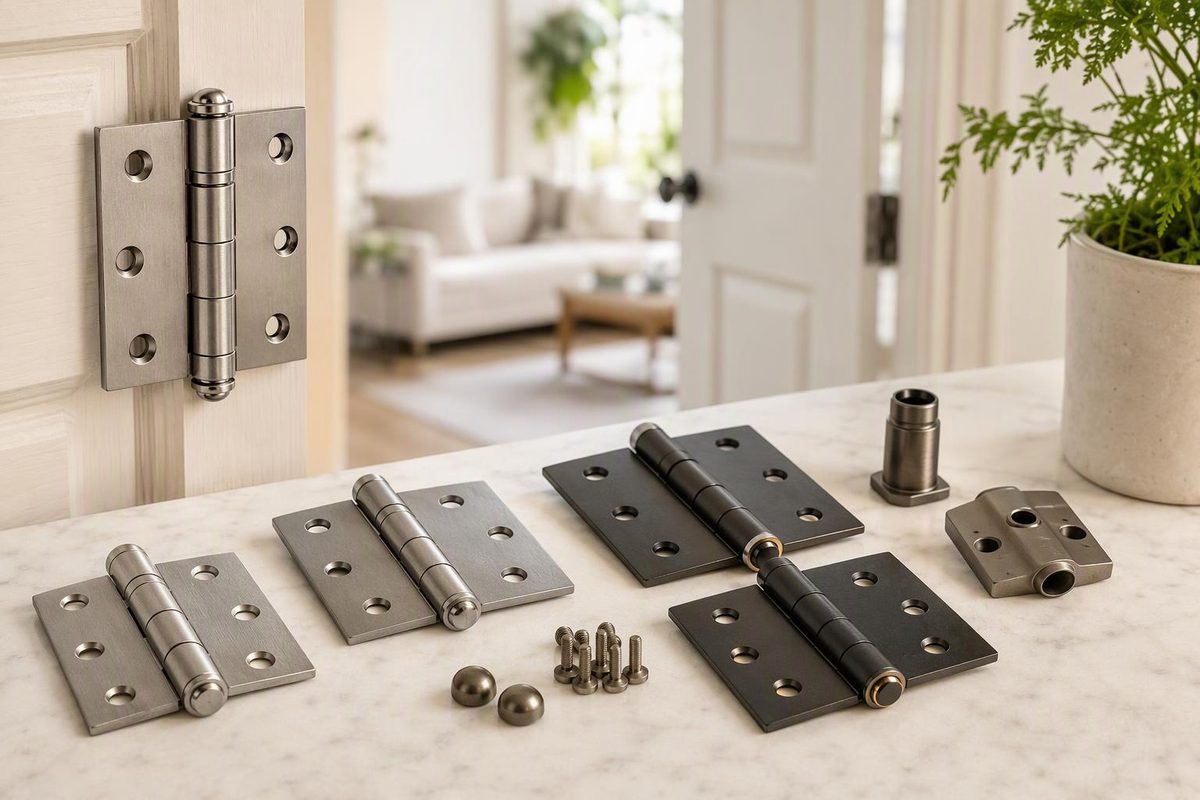
A ball bearing hinge uses bearing assemblies in its barrel to reduce friction as the door swings. It is worth considering for a heavier or frequently used door, but a drop-in replacement must match the existing hinge’s height, open width, leaf thickness, corner shape and screw preparation. Ball bearings alone do not establish the hinge’s weight class or suitability for the opening.
Standard-weight and heavy-weight ball bearing hinges can have the same height and width but different leaf thicknesses. Buying by nominal size alone can leave the replacement standing proud of its recess. Allegion’s hinge identification guide explains why their door and frame preparations differ.
Select the door’s service level, closer status and preparation match to see the selection direction.
Hinge Selection Check
Consider Standard-Weight Ball Bearing
Hager specifies BB1279 for medium-weight doors or medium-frequency service. This is a selection direction, not a load rating.
No closer selected; the service level still needs to match the exact manufacturer's guidance.
Preparation not checked: Do not treat the candidate as a drop-in replacement. Compare size, gauge, corners, screw preparation, mounting, security options and material.
Rated, egress, accessible and electrified openings need separate assembly and applicable-code verification. This check does not approve an installation.
Evidence Behind the Selection
| Condition | Direction | Scope |
|---|---|---|
| Light / low traffic | Plain bearing may suffice | Correct specification required |
| Medium service | Standard-weight ball bearing | Hager BB1279 guidance |
| Heavy / frequent | Heavy-weight bearing | Hager BB1199 guidance |
| With closer | Ball or concealed bearing | Ives guidance |
No universal numeric door-weight cutoff is supplied by these examples. Matching dimensions alone does not establish suitability.
Sources: Hager BB1279 and BB1199 specifications; McKinney hinge guide; Ives architectural hardware catalog; Allegion hinge identification guide, cited in the article.
Identify Bearing Housings, Then Confirm the Model
On a typical five-knuckle ball bearing butt hinge, look for small bearing housings between sections of the barrel. Hager’s standard-weight BB1279 has two bearing assemblies; its heavy-weight BB1199 has four. Both have five knuckles—the interlocking barrel sections around the pin.
The number of housings is an identification clue, not a substitute for the model specification. Do not use those two Hager models to infer the bearing count or weight class of every hinge.
The bearings let the knuckles ride smoothly on a bearing raceway rather than relying solely on plain bearing contact. They are not a closing mechanism. If the door needs to close automatically, that is a separate function supplied by suitable spring hinges or a closer, as described in the McKinney hinge guide. See spring-loaded hinge selection when self-closing is the task.
Match the Weight Class to the Door’s Service
Choose the bearing type and weight class from the door’s weight, dimensions, use and other hardware—not from finish preferences.
| Door Condition | Selection Direction |
|---|---|
| Lightweight, little traffic, no closer | A correctly specified plain-bearing hinge may be sufficient. |
| Medium-weight or moderate use | Consider a standard-weight ball bearing hinge. Hager specifies BB1279 for medium-weight doors or medium-frequency service. |
| Heavy door or high-frequency use | Check a heavy-weight bearing hinge against the manufacturer’s selection guide and existing preparation. Hager specifies BB1199 for heavy-weight doors and doors requiring high-frequency service. |
| Door with a closer | Follow the hinge manufacturer’s bearing-hinge guidance. Ives calls for ball bearing or concealed-bearing hinges on doors with closers. |
These are selection directions, not universal load ratings. The manufacturer guidance distinguishes lightweight/low-traffic, medium-service and heavy/high-frequency applications. The Ives architectural hardware catalog also includes the frame and other door hardware in its selection considerations.
The cited examples do not provide a universal door-weight cutoff for choosing standard- versus heavy-weight hinges. Use the exact manufacturer’s selection guidance rather than treating “ball bearing” as a load rating.
Match the Full-Mortise Preparation Before Ordering
For a full-mortise butt hinge, both leaves sit in recesses: one in the door edge and one in the frame. Record the existing hinge’s details, preferably with its model number and photographs.
| Check | What to Record |
|---|---|
| Height × open width | Height along the pin axis; width across both leaves with the hinge opened flat. Do not measure just one leaf. |
| Leaf thickness | Measure the flat metal away from the barrel and screw countersinks; compare with the replacement drawing. |
| Corners | Square or rounded; match the actual radius, not just “round corner.” |
| Screw preparation | Hole count and positions on each leaf, plus the specified fasteners for the door and frame material. |
| Mounting and geometry | Full mortise or another mounting type; any unequal leaves, wide throw or swing-clear geometry. Check handing where specified. |
| Pin and security options | Removable pin, non-removable pin (NRP), or security studs, as required for the opening. |
| Material and finish | Check the base metal separately from the decorative finish and confirm suitability for the exposure. |
Use the hinge measurement guide for the measuring sequence, then compare your record with the exact manufacturer template. Hager’s T308 template distinguishes size, gauge and screw preparation. The Ives catalog separately identifies mounting types, corner radii, security options and material substrates.
A nominal size match is only one part of this comparison. A different leaf thickness, hole pattern or corner radius can prevent the replacement from seating in the existing preparation.
A Heavy-Weight Hinge May Have the Same Outline but a Different Gauge
For a 4½ × 4½-inch (114 × 114 mm) hinge, the Ives catalog lists these gauges:
| Ives Model | Weight Class | Leaf Gauge |
|---|---|---|
| 5BB1 | Standard | 0.134 in. (about 3.40 mm) |
| 5BB1HW | Heavy | 0.180 in. (about 4.57 mm) |
The outline matches; the thickness does not. These thicknesses apply to the listed size and models, not every standard- or heavy-weight hinge.
A heavier hinge therefore is not automatically a drop-in upgrade. Allegion’s explanation of mixed standard- and heavy-weight hinges notes that the thinner hinge may need shimming, while the thicker one may stand proud. Avoid mixing weight classes without an approved fitting plan.
Separate Hinge Wear From Fastening and Alignment Faults
Before ordering hinges to cure rubbing or a misaligned latch, inspect whether the leaves are secure, screw holes are sound and the door’s gaps are even. A bearing upgrade is not a repair for damaged fastening points or incorrect alignment.
If the replacement does not match the preparation, resolve that mismatch before ordering. Choosing a higher weight class does not remove the need to check recess depth, fasteners and alignment.
Verify Requirements for Rated and Controlled Openings
For a fire-rated, egress, accessible or electrified opening, verify the complete assembly’s requirements and applicable local code before changing hinge material, gauge, count or function. Matching dimensions do not establish suitability.
For example, Hager’s BB1199 specifications state NFPA 80 suitability for the stainless-steel model, while the family also includes a brass version. That statement must not be extended to every material option. Read the exact model documentation and assembly instructions, not just the family name.