
Get a Closet Door Back on Track: Identify the Rollers First
Reseat a sliding or bifold closet door by identifying its rollers, guides and pivots, then check the hardware that caused it to derail.
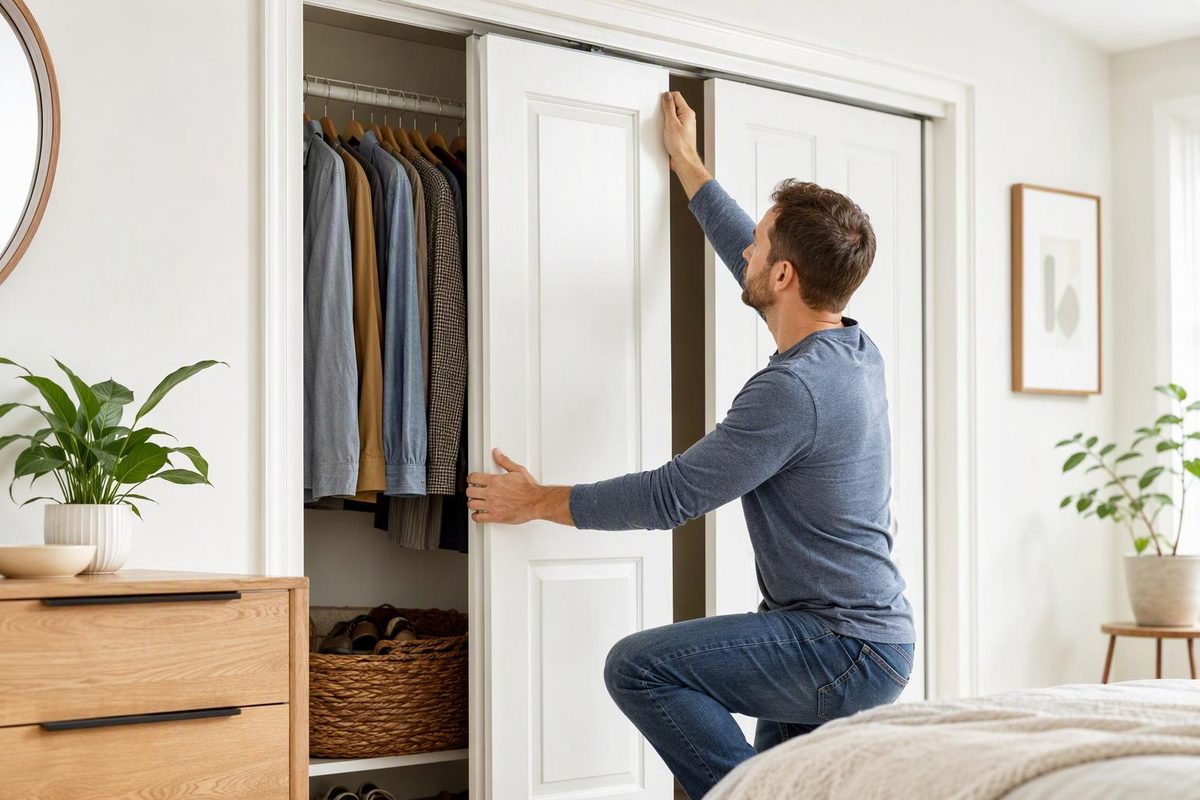
First find what supports the door: top rollers, bottom rollers or bifold pivots. A top-hung sliding door needs its wheels reseated on the overhead track; a bottom-rolling door needs its lower wheels seated on the floor track; a bifold may need only its spring-loaded guide returned to the upper track.
Do not force the panel upward until you have checked for retaining clips or locks. Support the door before adjusting anything, and use a helper for a heavy or mirrored panel. Stop if glass is cracked, the frame is coming apart or the track is pulling away from the opening.
Identify your closet-door hardware
Look behind the panel with a flashlight—not just at the door face.
| What you see | Door type | What to reseat |
|---|---|---|
| Wheels on hangers near the top; a small guide at the floor | Top-hung sliding/bypass | Upper wheels on their proper track rail, then the bottom edge in its guide |
| Wheel assemblies near the bottom; a continuous floor track and upper guide channel | Bottom-rolling sliding/bypass | Lower wheels on the floor rail, with the top guides in the matching channel |
| Two hinged panels; pivots near the jamb and a moving guide at the top of the outer panel | Bifold | The escaped guide, or the pivot assembly if that has also come loose |
These are distinct arrangements: Johnson’s 2200 bypass system is top hung, while Contractors Wardrobe’s Brittany instructions identify bottom steel wheels and nylon top guides.
Have a screwdriver that fits the hardware, a flashlight, a vacuum or brush, and a padded surface ready. Remove loose debris from the track and check for broken wheels, bent brackets and loose fasteners before rehanging.
Top-hung sliding door: reseat the upper wheels
These instructions apply to exposed-rail, tilt-in hangers. If the wheels are enclosed in a channel or connected through a locking hanger, follow that hardware’s release-and-reconnection instructions instead. If both upper wheels are still seated and only the bottom edge has escaped its guide, restore the guide engagement rather than unhooking the door.
- Support the panel. Check whether both top wheels have escaped or only one. Keep the bottom from swinging toward you.
- Clear the floor guide if necessary. If it prevents the required tilt, mark its position before temporarily removing it. Do not loosen the overhead track to create space.
- Return the wheels to the correct rail. For Johnson’s 1166/2200 arrangement, tilt the top of the door toward the closet, place the wheels on the rail and return the panel to vertical. If both panels are out, hang the rear panel first on the rear rail, then the front panel on the front rail. This sequence comes from the manufacturer’s installation instructions.
- Check both wheels before releasing your support. Neither should sit on the wrong rail or catch on a track lip.
- Restore the floor guide and align the door. Adjust the hangers so the door edge is parallel to the side jamb; position the guide so the panels pass without rubbing. Johnson specifies hanger alignment and the floor guide after hanging the doors in those same instructions.
If the door will not seat with a controlled tilt, stop and identify the hanger rather than bending the track.
Bottom-rolling sliding door: seat the lower wheels
The sequence below follows the Contractors Wardrobe Brittany system. Use it only for matching tilt-in hardware; other systems may have different guides or anti-jump devices. Keep each panel’s top guides and bottom wheels in corresponding front or rear channels.
- Support the panel and inspect the bottom wheels. A broken or seized wheel needs repair, not repeated reseating. Check the manufacturer’s required roller extension before rehanging. Brittany’s instructions call for 1 inch (25.4 mm) of roller showing before installation to avoid scratching the bottom track; do not transfer that setting to another model.
- Engage the upper channel first. On the Brittany system, tilt the top toward the closet and insert it into the upper runner.
- Set both lower wheels onto the matching floor runner. Bring the panel upright while keeping the top guides engaged. If reinstalling both doors, fit the rear panel first.
- Adjust alignment at the lower wheel assemblies. Make small changes, checking that the door edge aligns with the side jamb and that the panel remains engaged at the top.
The roller preparation, top-first hanging sequence and lower-wheel adjustment are documented in the Brittany installation instructions. Adjustment-screw direction is model-specific.
Bifold door: check the guide separately from the pivots
If only the moving top guide has popped out, and both jamb-side pivots remain seated:
- Partly fold the panels and support the outer panel.
- Depress the spring-loaded guide pin or roller.
- Position it directly beneath the track opening and release it into the track.
- Confirm that it is captured before opening the door slowly.
This is the spring-loaded guide arrangement shown in Lowe’s bifold installation guide.
If a jamb-side pivot has also come out, support the entire folded pair. For the conventional arrangement in that guide, insert the upper pivot into its bracket, seat the lower pivot, then engage the moving guide. Check the height and alignment; the panels should not rub the floor or header.
Not every bifold uses that mechanism. Johnson’s 1700 hardware, for example, requires the upper pivot’s tab lock to be secured and the lower pivot inserted into a socket arm. Do not force a locking assembly as though it were a spring-loaded pin.
If it comes off again, repair the cause
Open and close the door slowly through its full travel. Stop at any catch and inspect that location.
- Wobbling, cracked or seized wheel: replace the roller or hanger assembly.
- Loose floor guide or pivot bracket: restore secure mounting before further use.
- Bent track or loose overhead fixing: repair the track or attachment; do not rely on repeated reseating.
- Floor rubbing or uneven side gap: adjust the appropriate hanger, roller or pivot within its permitted range.
- Guide or retaining lock that will not stay engaged: identify and replace the damaged component.
Before ordering parts, photograph the assembly and record its markings, wheel diameter, bracket offset, mounting-hole spacing and track profile. For bifolds, also record the pin diameter and socket style. Compare those measurements with the replacement drawing—not merely a listing labeled “closet-door roller.”