
Match the Cylinder to Your Lock Before You Take Anything Apart
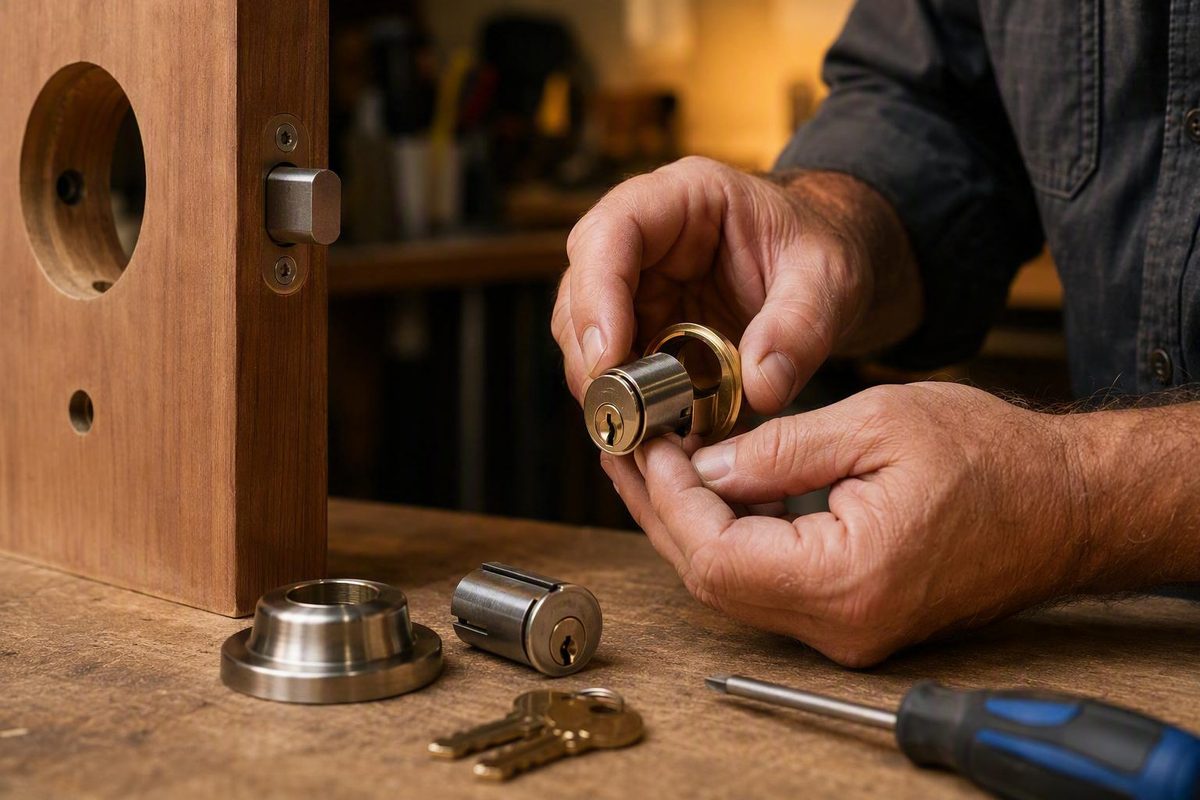
A cylinder that accepts an SC1-style or Schlage C-keyway key may still have the wrong body, housing height, length, tailpiece or retaining method.
Research and source review by The Door Folks editorial desk.
A Schlage lock cylinder replacement is not a matter of matching the old key’s shape and buying the first cylinder labeled “Schlage.” The keyway may match while the cylinder body, length, tailpiece, retaining arrangement, or keying does not.
This is a verification and installation framework rather than a universal model-to-part catalog. Begin by identifying the exact lock and cylinder format. Then decide whether the problem calls for rekeying, cylinder replacement, another lock repair, or complete-lock replacement.
The correct service path also differs among residential mechanical deadbolts, motorized locks, BE365 keypad locks, commercial cylindrical hardware, and interchangeable-core systems.
First decide whether the cylinder is actually the part to change
It can be appropriate when the cylinder is the failed or unsuitable component, although another part of the lock may sometimes need attention as well.
Schlage says most of its residential locks have removable cylinders, but that does not mean every product uses the same cylinder or service procedure. Its guidance illustrates B60 and B62 as mechanical deadbolts and BE489, BE499, BE459, and BE469ZP as motorized deadbolts. It also requires BE365 cylinder work to be performed by a certified locksmith, warns that removing the model’s torque screws by other means can void the Schlage Residential Warranty Policy, and directs mechanical-deadbolt users to Customer Care when a replacement cylinder is too short for the retaining screw to secure it. These model groupings, procedures, and stop conditions come from Schlage’s residential cylinder-replacement guidance.
Use the condition of the entire lock—not merely the absence of a working key—to choose a service path:
- Consider rekeying when the cylinder works normally but the keying needs to change. Examples include a lost key, a tenant change, or a desire to have compatible locks operate from the same key.
- Consider cylinder replacement when the keyed component is missing, damaged, badly worn, or unable to provide the required keying.
- Diagnose the complete lock when the bolt, latch, chassis, thumbturn, keypad, motor, or power system is malfunctioning. A different cylinder will not by itself correct a failed motor, damaged latch mechanism, or door-alignment problem.
- Consider complete-lock replacement after diagnosis. The evidence does not establish one universal point at which every Schlage lock should be replaced rather than repaired. The decision depends on the failed component, lock condition, availability of compatible parts, and exact model.
The available service may depend on the cylinder’s condition, the key system, the presence or absence of a working key, whether the cylinder must be removed, and the capabilities of the locksmith or supplier.
Diagnose the symptom with the door open
The following is an editorial diagnostic check, not a substitute for the instructions for your exact model. Keep the door open and operate every available control several times:
- Insert and remove the key without turning it.
- Turn the key and note whether the plug feels rough or restricted.
- Operate the thumbturn independently.
- Extend and retract the bolt or latch.
- If the lock is electronic, test the keypad or credential reader, motorized movement, and relocking function.
It may also be necessary to investigate how the cylinder engages the rest of the lock.
Electronic symptoms also require care. If the keypad accepts an entry but the motor does not complete its cycle, changing the keyed cylinder may have no effect. Conversely, working electronics do not prove that the mechanical cylinder has the correct keying or engagement.
Unresolved chassis, bolt, latch, or electronic faults should be assessed through model-specific Schlage support or by a qualified locksmith. The rest of this guide separates four service paths:
- Residential mechanical deadbolts
- Motorized or electronic deadbolts
- BE365 keypad locks
- Commercial locks and interchangeable-core hardware
Identify the exact lock and cylinder format before ordering
The exact model or series is the first compatibility checkpoint. “Schlage” identifies the manufacturer, not a complete replacement-part specification.
Record model or series information from any reliable material available:
- The lock and removable trim
- Retained packaging
- A purchase receipt or online order history
- The original installation guide
- Property-maintenance records
- Schlage support documentation
- Previous locksmith or key-system records
The evidence does not establish one universal location where every Schlage model number appears. Do not order by guessing from trim shape, finish, or keypad appearance if the model remains uncertain.
Sort the lock into the correct product group
First determine whether the hardware is residential or commercial. Then distinguish mechanical operation from keypad, credential, or motorized operation.
Schlage’s residential groupings can help select the appropriate service path, but they do not prove that one cylinder fits every model in a group. A keypad also does not identify a universal internal design. In particular, identifying a lock as a BE365 is a stop condition for owner cylinder service; follow the manufacturer requirement cited above.
Commercial hardware requires another level of identification. Series, model, function, cylinder format, and configuration can all affect the applicable document. Schlage Commercial maintains an index with separate entries for an S-Series IC Core Conversion Kit, B-Series and D-Series interchangeable-cylinder assemblies, and model-specific B-Series deadbolts. The index includes full-size interchangeable-core documents for B660, B760, B661, and B761 single-cylinder configurations and B662, B762, and B862 double-cylinder configurations. Schlage Commercial’s installation index identifies these documents and model groups.
Those listings confirm that model-specific documents exist. They do not establish one removal or assembly method for all the listed locks.
Conventional cylinder versus interchangeable core
A conventional-cylinder procedure may involve removing trim or the lock, releasing a retaining screw, and withdrawing the complete cylinder assembly. The housing, core format, and control method must match.
Do not apply a conventional residential deadbolt procedure to an interchangeable core merely because both parts contain a key plug. Likewise, a commercial IC conversion document does not apply to a residential keypad or smart deadbolt without model-specific support.
Identification worksheet
Complete this worksheet before shopping:
| Field | What to record |
|---|---|
| Manufacturer | Schlage, plus any other branding visible on the assembly |
| Exact model or series | Full designation, not a visually similar product name |
| Use | Residential, multifamily, institutional, or another commercial application |
| Operation | Mechanical, keypad, motorized, credential-operated, or mixed |
| Lock type | Deadbolt, knob, lever, cylindrical lock, or another format |
| Cylinder format | Conventional removable cylinder or interchangeable core |
| Existing keyway | Record only if known; do not infer it from appearance |
| Door application | Exterior, interior, communicating, storefront, or another use |
| Door information | Thickness and any unusual trim or adapter arrangement |
| Keying requirement | Keyed different, keyed alike, or matched to an existing system |
| Photographs | Exterior, interior, door edge, cylinder, tailpiece, and retainers |
| Existing part details | Markings, dimensions, tailpiece shape, and finish |
Photograph each layer during disassembly only when the exact model permits owner service. A ruler can help document dimensions, but an approximate measurement is not a substitute for a specified replacement part.
If you cannot establish the model, series, or cylinder format, pause the purchase. Ask Schlage or a qualified residential or commercial locksmith to identify the required component from the lock, documentation, and photographs.
A Schlage keyway is not the same as a Schlage lock fit
It does not establish that the surrounding cylinder fits the lock.
A cylinder may accept an SC1-style or Schlage C-keyway key while having the wrong body, housing height, length, tailpiece, or retaining method.
Key fit versus lock fit
| Key fit and keying | Physical lock fit |
|---|---|
| Keyway profile | Exact lock model or series |
| Compatible key blank | Conventional cylinder or interchangeable-core format |
| Pin positions and arrangement | Cylinder-body dimensions |
| Keyed alike or keyed different | Housing length and height |
| Pinning matched to an existing key or code | Tailpiece shape, dimensions, reach, and orientation |
| Key-code service, where offered | Door thickness and trim arrangement |
| Retaining screw, clip, housing, or other retention method | |
| Chassis application and required finish |
Both sides must be correct. Passing the key-fit checks does not compensate for a physical mismatch, and a cylinder that physically seats will not operate from an existing key unless its keyway and pinning are compatible.
Pre-purchase compatibility checklist
Confirm every applicable item before ordering:
- Exact lock model or series
- Residential or commercial application
- Conventional cylinder or interchangeable-core format
- Correct keyway
- Cylinder or housing length
- Housing height, where relevant
- Tailpiece type and dimensions
- Tailpiece reach and permitted orientation
- Door thickness
- Trim and cylinder finish
- Retaining arrangement and required hardware
- Single-cylinder or double-cylinder application
- Required keying
- Package contents
- Model-specific installation or warranty restrictions
These are separate specifications. All About Doors lists generic flat-tail housings in 1-inch and 1-1/16-inch heights and warns that those heights are not always interchangeable. It also says its applicable flat tailpieces normally have breakaway marks at quarter-inch intervals and can be rotated 180 degrees. Those statements concern the retailer’s generic product category, not every Schlage cylinder. All About Doors’ flat-tail guide identifies the housing-height, keyway, and tailpiece checks.
Door thickness and trim depth affect how far a tailpiece must reach. Use the limits and adjustment method documented for the exact replacement rather than assuming a universal Schlage measurement.
Treat “fits Schlage keyways” as a narrow statement
A product advertised for Schlage keyways is not necessarily documented for a named Schlage lock.
Prime-Line E 2103 is a useful bounded example. Home Depot describes it as a 1-1/4-inch aftermarket cylinder designed for Schlage keyways, supplied with two keys, and equipped with a trimmable tailpiece. The listing does not establish compatibility with every Schlage lock or provide a complete model list. See Home Depot’s specifications for Prime-Line E 2103.
Do not infer physical compatibility from:
- The appearance of the old and new keys
- The fact that an existing key enters the new plug
- A retailer’s use of “Schlage shaped”
- A general SC1 description
- The presence of “Schlage” in a keyway selector
- A cylinder that appears to fit the trim opening
Prefer documentation naming the exact model or series. When only series-level compatibility is given, confirm dimensions, function, cylinder format, and supplied components separately.
Choose between OEM, aftermarket, and keying configurations
OEM status does not eliminate the need to match the component to the exact lock. Aftermarket status also does not prove that a part will fit or fail. In either case, compatibility depends on the model, cylinder format, dimensions, tailpiece, retention, and application.
Series-level products are not universal products
Retailers list SC40-100 as a replacement cylinder for Schlage A, AL, and D Series locks and require a keyway selection when ordering. That is useful series-level evidence, but it does not confirm every model, function, dimension, finish, or included component within those series. The Taylor Security listing identifies the SC40-100’s A, AL, and D Series positioning and ordering options.
Use a series-level listing to narrow the search, not to bypass model verification.
The Schlage 23-105 shows why seller attribution matters. Door Hardware Center markets it as a genuine brass, five-pin C-keyway cylinder primarily for B60 deadbolts and says that two keys are included. The seller’s Q&A additionally says it can be used with a B62 after changing the tailpiece and names F58CAM as another application. The same Q&A says the 23-105 does not fit BE469ZPRF and suggests 23884356C instead. These additional fit statements are retailer claims, not manufacturer confirmation in the available evidence. Door Hardware Center’s listing contains the product description and attributed compatibility answers.
Treat an unconfirmed alternative part number as a question to verify with Schlage, not as an approved buying answer.
Decide how the new cylinder should be keyed
Physical compatibility and keying are separate ordering decisions:
- Specified key code: The seller pins the cylinder to a supplied code where that service is available and appropriate.
- Matched to an existing key: A locksmith or qualified supplier determines whether the keyway and key system permit the replacement to be pinned for that key.
Choosing a C or SC1-compatible keyway does not make the cylinder operate from your current key. The keyway must accept the key profile, and the pinning must match the key.
Do not provide a key code casually or assume that every retailer can reproduce every system.
Verify package contents
Read the exact listing instead of relying on product photographs. Confirm whether the package includes:
- Keys
- The correct tailpiece
- A retaining screw
- Clips or other retainers
- Spacers or adapters
- Shields or trim components
- Installation instructions
A listing that says “cylinder with two keys” does not establish that a retaining screw, alternate tailpiece, anti-drill shield, or other assembly component is included.
Price, discounts, stock, shipping speed, and review counts are not compatibility evidence. Select a component by verified fit and service requirements rather than by whichever similarly labeled cylinder is easiest to order.
Replace a supported residential mechanical deadbolt cylinder
This procedure is limited to supported residential locks with removable conventional cylinders. Do not transfer it automatically to knobs, levers, commercial cylindrical locks, interchangeable cores, BE365 locks, or electronic models not covered by the relevant instructions.
Work with the door open and maintain access to both sides. Do not close it until every available mechanical and electronic function has been tested.
General Schlage-supported sequence
For a supported residential mechanical deadbolt:
- Uninstall the lock if necessary. Follow the installation documentation for the exact model and keep parts in assembly order.
- Locate the cylinder retaining screw. Confirm that it is the cylinder retainer shown for the model rather than an unrelated fastener.
- Remove the retaining screw.
- Withdraw the cylinder. Schlage’s documented methods are to pull on the metal driver bar or tip the assembly so the cylinder falls out.
- Place the compatible replacement cylinder in position.
- Reinstall the retaining screw.
- Reinstall the lock according to its model-specific instructions.
The replacement should seat naturally. Do not hammer, pry, or force it into position. The retaining screw must align correctly and hold the cylinder securely.
If the screw will not align, remove the replacement and recheck its seating, length, and format. Do not substitute an unverified fastener to make an incorrect cylinder appear secure.
For a mechanical deadbolt whose replacement cylinder is too short to be retained, apply the Schlage stop condition cited earlier: do not force or improvise the assembly; contact Customer Care.
Editorial open-door acceptance test
The following test is a conservative editorial recommendation rather than an additional manufacturer procedure:
- Insert and remove the key several times.
- Turn the key through its complete operating range.
- Operate the thumbturn independently.
- Extend the bolt fully.
- Retract the bolt fully.
- Return the lock smoothly to the unlocked position.
- Confirm that the cylinder remains stationary and retained.
- Repeat the complete cycle several times.
Stop if the cylinder moves, the retaining screw does not align, the key binds, or the bolt cannot complete its travel. The closed door should not be the first full operational test.
Handle motorized deadbolts and BE365 as separate cases
BE365 stop condition: Do not begin a DIY BE365 cylinder swap. Use a certified locksmith and do not attempt to bypass the model’s torque-screw arrangement. This is a manufacturer service and warranty restriction, not a general editorial preference.
A keypad or motor does not make the keyed cylinder universal. Do not copy a B60 or B62 procedure into an electronic lock without checking the exact model and its instructions.
For the motorized deadbolts illustrated by Schlage—BE489, BE499, BE459, and BE469ZP—the driver bar must be horizontal before the lock is installed on the door. The protruding bump on the bar should be on its upper-right edge. The same guidance contains the BE365 certified-locksmith and warranty restriction. Schlage illustrates the motorized driver-bar orientation and states the BE365 service condition.
Do not compensate by forcing the motor, bending the bar, or making undocumented internal adjustments.
The available evidence does not provide an official replacement-cylinder part number or model-specific compatibility procedure for BE489WB. General third-party suggestions about a C-keyway replacement are insufficient to authorize a purchase or procedure for that model. Confirm the exact component through Schlage documentation or support.
Test every operating mode
After authorized work on a supported motorized model, leave the door open and test:
- Mechanical key insertion, removal, and rotation
- Thumbturn operation, if present
- Keypad or credential entry
- Motorized bolt extension and retraction
- Manual unlocking after an electronic cycle
- Relocking
- Cylinder retention
If the key works but the keypad or motor does not, do not assume the cylinder is defective. If the electronic functions work but the key does not, recheck the keying, cylinder compatibility, and driver engagement. Mixed symptoms require model-specific diagnosis.
Use model-specific instructions for commercial cylinders and interchangeable cores
Do not use the residential procedure as a general method for Schlage commercial locks. Commercial service depends on the exact series, model, function, cylinder format, and configuration.
The Schlage Commercial index includes:
- S-Series IC Core Conversion Kit instructions
- B-Series and D-Series Interchangeable Cylinder Assembly Instructions
- Full-size interchangeable-core instructions for B660, B760, B661, and B761 single-cylinder deadbolts
- Instructions for B662, B762, and B862 double-cylinder configurations
- Separate B580/B580F, B571/B581/B581F, and B500 Series documents
The index confirms that these documents exist but does not provide their actual removal, conversion, or assembly steps. Open the document matching the exact hardware and follow it rather than reconstructing a procedure by analogy. Use Schlage Commercial’s model-specific instruction index to locate the applicable document.
Lock function can matter as well; visually similar commercial locks may have different internal configurations.
The SC40-100 retail example shows that series-specific replacement products are sold for A, AL, and D Series locks. It does not prove that one configuration fits every lock in all three series. Confirm the exact model, function, keyway, dimensions, finish, and package contents.
Escalate to a commercial locksmith or institutional hardware specialist when any of the following is uncertain:
- Lock series
- Functional configuration
- Conventional-cylinder or interchangeable-core format
- Existing master-key system
- Required keyway
- Core or cylinder control method
- Approved conversion kit
- Tailpiece or cam configuration
- Authorization to duplicate or change the keying
Do not apply commercial B-, D-, or S-Series instructions to residential Encode, Connect, Sense, or keypad hardware. A shared manufacturer name does not make the assemblies equivalent.
Troubleshoot fit and operation before closing the door
The following symptom matrix is editorial diagnostic guidance. It distinguishes documented stop conditions and retailer-specific adjustment advice from general checks.
Do not respond to resistance by applying more force. Binding may indicate an incorrect part, an orientation problem, a keying mismatch, faulty retention, or an unrelated problem elsewhere in the door assembly.
| Symptom | What to check | Response |
|---|---|---|
| Mechanical-deadbolt cylinder is too short for the retaining screw | Cylinder length, format, and seating | Apply the cited Schlage stop condition and contact Customer Care |
| Retaining screw will not align | Seating, cylinder length, and format | Remove and recheck; do not force the screw or substitute an unverified fastener |
| Applicable generic flat-tail cylinder fits but does not operate | Tailpiece orientation | Follow the exact product instructions; All About Doors advises rotating its applicable flat tailpiece 180 degrees and retesting |
| Tailpiece appears too long | Exact part design and authorized adjustment method | Shorten it only if documentation for that specific part permits adjustment |
| Key enters but will not rotate | Keyway, keying, and plug condition | Verify both the key profile and pinning |
| Key rotates but the bolt does not move | Tailpiece engagement and internal mechanism | Remove and verify the fit; do not force the key |
| Cylinder moves in the housing | Retainer, screw alignment, and cylinder dimensions | Stop using the lock until the cylinder is secured correctly |
| Bolt works with the door open but binds when closed | Door, frame, and strike alignment | Treat alignment as a separate problem |
| Mechanical key works but electronics fail | Power, motor, setup, or model-specific fault | Use the model-specific Schlage support process |
| Electronics work but the key fails | Keying, cylinder fit, or driver engagement | Recheck the mechanical installation and specified cylinder |
Reversed flat tailpiece
All About Doors says the flat tailpiece on its applicable generic cylinders can be rotated 180 degrees. Its recommendation for a cylinder that fits but does not operate is to remove the cylinder, rotate the tailpiece, reinstall it, and retest.
That is retailer guidance for a product category, not a universal Schlage instruction. Perform the adjustment only when the exact replacement permits it. Never twist a fixed tailpiece or use the lock mechanism to force it into another orientation.
Overlong tailpiece
Some generic flat tailpieces have breakaway marks at quarter-inch intervals, and some individual aftermarket products are advertised as trimmable. Neither fact authorizes shortening every tailpiece.
Cut, snap, or trim a tailpiece only when the documentation for the exact component says it is designed for that adjustment and explains how to determine the required length. Do not grind, bend, cut, snap, or exchange an undocumented tailpiece merely because a similar-looking product can be modified.
For a B62 being considered with a 23-105 cylinder, the available statement is limited to Door Hardware Center’s claim that the tailpiece must be switched. Confirm the exact cylinder, approved replacement tailpiece, and procedure with Schlage before proceeding.
Key enters but does not operate the lock
Return to both halves of the compatibility question:
- Does the keyway accept the key profile?
- Is the cylinder pinned for that particular key?
- Does the tailpiece engage the lock?
- Is the tailpiece in an authorized orientation?
- Does the cylinder seat at the correct depth?
- Is the retained lock mechanism functional?
A key entering the plug proves only that its profile can enter that keyway. It does not establish correct pinning or physical lock fit.
Bolt binds only with the door closed
If the key and thumbturn move the bolt smoothly with the door open but the bolt binds at the closed-door strike, investigate alignment separately. Check whether the door has shifted, whether weather sealing changes its position, and whether the bolt still lines up with the strike opening.
Do not automatically blame or modify the cylinder to compensate for a closed-door alignment problem.
Final verification-first checklist
Keep the door open until every applicable statement is true:
- The exact lock model or series has been identified.
- The cylinder format is known.
- Keyway compatibility and physical lock fit have been checked separately.
- Cylinder-body dimensions and housing height are correct.
- The tailpiece is the correct type, length, and authorized orientation.
- The required keying was selected.
- The cylinder seats without force.
- The retaining hardware aligns and secures it.
- The key inserts, turns, and withdraws smoothly.
- The thumbturn operates through its complete range.
- The bolt or latch fully extends and retracts.
- The cylinder does not move in its housing.
- Any keypad, credential, motor, and relocking functions work repeatedly.
- No undocumented tailpiece or hardware modification was required.
Stop when the model is uncertain, the lock is a BE365, the cylinder moves, the retaining hardware cannot secure it, binding remains unexplained, electronics fail, or a proposed modification is not authorized by the exact component documentation.
Frequently asked questions
Will any SC1 or Schlage C-keyway cylinder fit my Schlage lock?
No. SC1 or Schlage C-keyway compatibility concerns the key profile. The cylinder must also match the lock model or series, cylinder format, body dimensions, housing height where applicable, tailpiece, door application, and retaining arrangement.
Your existing key will operate the replacement only if both the keyway and pinning match. A key that enters the plug does not establish physical fit or correct keying.
Can I replace a Schlage BE365 cylinder myself?
No. The BE365 stop condition above governs: cylinder work belongs with a certified locksmith, and the model’s torque screws should not be bypassed during a DIY attempt.
What should I do if the new cylinder is too short for the retaining screw?
For a supported mechanical deadbolt, use the manufacturer stop condition described above. Confirm that the replacement is fully seated and that its model, format, and length are correct. If the retaining screw still cannot secure it, do not force the screw or substitute another fastener; contact Schlage Customer Care.
Can a replacement cylinder be keyed to match my existing Schlage keys?
Potentially. The replacement must have a compatible keyway and be capable of being pinned for the existing key or key system. Some suppliers offer keyed-alike service or ordering to a specified key code.
That service is separate from physical compatibility. Confirm that the cylinder fits the lock, then ask the supplier or locksmith whether it can be keyed appropriately. Selecting “C” or “SC1” alone will not make the current key work.
Is the Schlage 23-105 cylinder confirmed for B60, B62, or BE469ZPRF?
The available retailer evidence markets the 23-105 primarily for B60 deadbolts. Door Hardware Center also says it can be used with B62 after a tailpiece change, but that statement comes from seller Q&A rather than manufacturer documentation in the evidence available here.
The same seller says the 23-105 does not fit BE469ZPRF and suggests another part number. Treat both statements as leads to verify with Schlage before ordering, not as official compatibility confirmation.
A successful Schlage lock cylinder replacement follows a verification-first order: identify the exact lock, establish the cylinder format, separate keyway compatibility from physical fit, confirm the body and tailpiece, choose the required keying, follow the correct model-class procedure, and test every function with the door open.
Keep the two manufacturer stop conditions in view: BE365 cylinder work belongs with a certified locksmith, and a mechanical-deadbolt cylinder that cannot be secured because it is too short must not be forced. When the model, approved tailpiece, or replacement component remains uncertain, confirmation from Schlage or a qualified locksmith is safer than adapting a merely similar cylinder.