
Surface Mount Hinge: Identify the Type and Check the Fit
Distinguish full-surface, half-surface and no-mortise hinges, then check mounting space, door thickness, fasteners and swing before ordering.
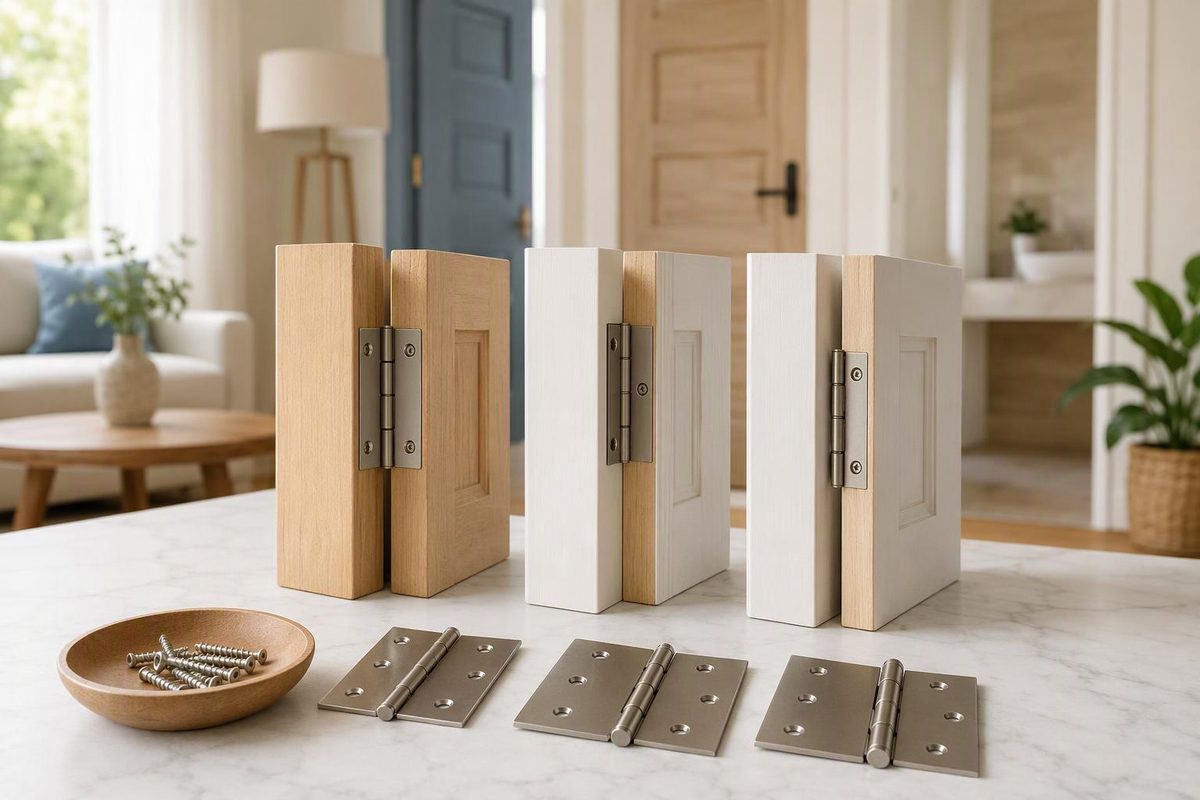
A surface-mounted hinge leaf attaches directly to the door or frame rather than sitting in a recessed mortise. But the name alone does not establish fit: a full-surface door hinge, a half-surface hinge and a nested no-mortise cabinet hinge have different mounting arrangements. Identify where each leaf—the plate that attaches to the door or frame—mounts, then match the manufacturer’s drawing, door thickness and fastening requirements before choosing a finish.
Identify the mounting arrangement
Open the door and inspect both leaves. Look for recesses beneath them, not just whether the hinge is visible when the door closes.
| Type | Where the leaves mount | Replacement check |
|---|---|---|
| Full-surface door hinge | One leaf on the door face; the other on the frame surface | Match both mounting surfaces, leaf geometry and pivot position. |
| Half-surface butt hinge | Door leaf on the door face; frame leaf recessed into the frame | The frame mortise still needs to match. This is not an entirely no-mortise installation. |
| Half-mortise butt hinge | Door leaf recessed into the door edge; frame leaf surface-mounted | Do not confuse it with half-surface mounting. |
| Full-mortise butt hinge | Both leaves recessed: one into the door edge and one into the frame | Match the existing recesses, leaf thickness and screw preparation. |
| Nested no-mortise cabinet hinge | One leaf nests inside the other when closed, avoiding a mortise | Match the closed gap, leaf dimensions and intended door application. |
The first four arrangements follow Hager’s commercial butt-hinge definitions. Rockler’s hinge glossary distinguishes nested no-mortise hinges from face-mounted cabinet hinges; it also explains that a nested hinge’s leaf thickness sets the spacing.
Continuous hinges need their own cross-section drawing. Do not transfer a butt-hinge preparation rule to a full-height geared hinge merely because both use “half surface” in the name. For example, SELECT’s SL54 half-surface continuous hinge has a frame leaf designed to cover existing butt-hinge preparations. SELECT half-surface specifications
If both existing leaves sit in recesses, start with our full-mortise hinge replacement guide, rather than assuming a surface-mounted model will be a drop-in replacement.
Record these measurements before ordering
Photograph the hinge open and closed, including any stamped model number. Record dimensions in inches or millimetres consistently.
- Door size and construction: height, width, thickness, material and weight if known. Include added hardware when establishing the load. Hager identifies door weight, width and frequency of use as selection factors—not hinge size alone. Hager selection guidance
- Hinge dimensions: height, each leaf’s width, thickness, bends or offsets, and screw-hole centres. For a continuous hinge, record its overall length and compare the cross-section as well as the hole pattern. Use our hinge-measurement guide for a conventional butt hinge.
- Mounting space: usable frame-face width and door-face space. Measure the actual flat surface available, excluding trim or obstructions.
- Closed position and clearances: whether the door face is flush with or inset from the frame, plus the gaps around the door. Compare these with the chosen model’s instructions; “no mortise” does not mean “no clearance required.”
- Swing and handing: photograph which side carries the hinges and whether the door swings toward or away from you. Check the model’s handing instructions, opening angle and clearance from trim, walls and closer hardware.
A concrete example shows why these checks matter: SELECT’s SL57 requires at least 7/8 inch (22.2 mm) of frame-face width. Its standard barrel nuts accommodate doors 1-3/8 to 1-3/4 inches (34.9–44.5 mm) thick; long barrel nuts are available for 2 to 2-1/4 inch (50.8–57.2 mm) doors. Those are SL57 requirements, not universal surface-hinge dimensions. SELECT full-surface specifications and installation instructions
Check the fastening and installation plan
Surface mounting avoids recessing the surface-applied leaves; it does not eliminate drilling or other door preparation. SELECT’s SL21/SL57 instructions, for example, require through-holes for barrel nuts and shoulder screws. They also distinguish wood-frame from metal-frame fasteners and place the shoulder screws on the secured side of the door. SELECT installation instructions
Before buying, confirm that the specified fasteners and any required reinforcement suit the door and frame. A matching hole pattern is not enough if the mounting material is damaged or cannot hold the prescribed fastening system.
Changing hinge geometry can also affect other hardware. SELECT specifically requires repositioning existing overhead closers when installing its swing-clear SL21; otherwise, the door cannot open beyond 70 degrees. Check the closer arrangement whenever changing the pivot position. SL21/SL57 instructions
For a fire-rated opening, confirm with the door and frame manufacturers that their listings permit the retrofit and how existing hinge preparations must be filled. Allegion’s guidance on continuous-hinge retrofits specifically recommends these checks. For fire-rated, egress, accessible or electrified openings, verify the complete assembly’s requirements and applicable local code before drilling or changing hinge type. A hinge’s individual rating or matching dimensions do not establish suitability for the whole opening.
Order by model and mounting geometry first; finish comes last. If the drawing does not resolve the frame width, closed-door position or fastening method, send the measurements and photographs to the manufacturer before ordering.