
Dummy Door Sets: Fixed Pulls, Not Latching Handles
A dummy set is a fixed knob or lever with no latch or lock. Compare it with passage and privacy hardware, and check mounting before ordering.
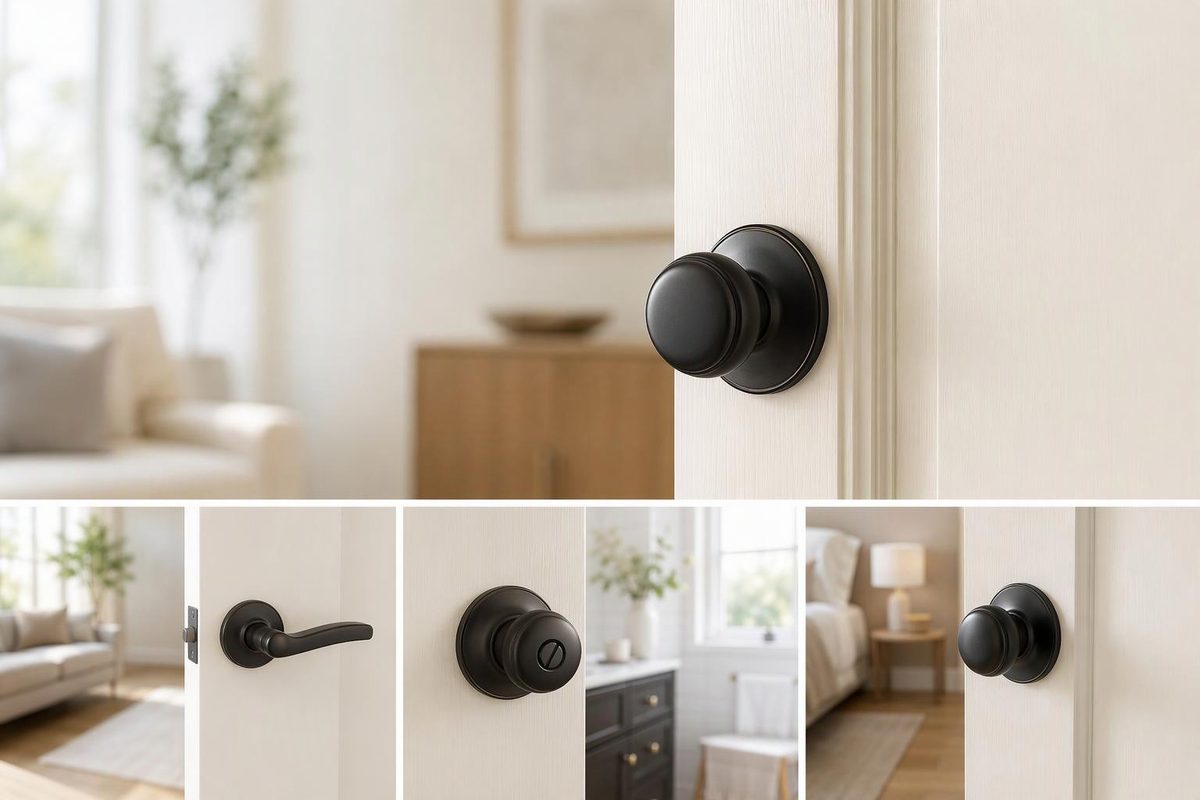
A dummy set is a fixed, non-turning door knob or lever that serves as a pull, without operating a latch or lock. It can match the appearance of working door hardware, but the handle is used to move the door rather than retract a latch. Manufacturers also call this function pull only, inactive or non-turning. Kwikset’s function guide identifies dummy hardware as pull-only trim with no mechanical latch mechanism.
Dummy does not mean broken or purely ornamental: the handle provides something to grip. It simply does not latch or lock the door.
Dummy vs. passage vs. privacy
Choose the function before choosing the finish. A closet door can need either a dummy pull or a working passage set, depending on how it stays closed.
| Function | Does the knob or lever turn? | Operates a latch? | Locks? | Choose it when… |
|---|---|---|---|---|
| Dummy | No | No | No | The door needs only a pull |
| Passage | Yes | Yes | No | The door needs to latch but not lock |
| Privacy | Yes | Yes | Yes, for privacy | An interior door needs a privacy lock |
Kwikset’s installation guide distinguishes non-rotating dummy knobs from the latched passage and privacy versions; its function guide explains hall/closet and bed/bath operation.
Non-locking does not mean dummy. A passage set is non-locking too, but its handle retracts a latch.
Where a dummy set makes sense
Pantries and shallow closets are common pull-only applications, as Kwikset notes. Before ordering, check what actually holds your door closed. A dummy handle supplies no holding mechanism, so any catch or bolt must work separately.
On a double-door pair, distinguish the active leaf—the door normally opened—from the inactive leaf. Matching dummy trim does not release the inactive door’s bolts. If that leaf is secured with flush bolts, identify those separately using the flush-bolt replacement guide.
Also check how many handles the package contains. One-sided dummy trim serves one face of a door; a two-sided set serves both faces. For example, Baldwin’s full dummy set includes two knobs or levers, two roses—the trim plates at the handle bases—and mounting hardware, not two complete door sets.
Check mounting before replacing one
Do not assume all dummy sets mount to an unbored door. Two documented designs show why the exact model matters:
- Face-mounted: Schlage’s J-Series dummy instructions specify two pilot holes and wood screws into the door face.
- Through-bore: Baldwin’s Reserve full-dummy drilling instructions specify a 2⅛-inch (54 mm) hole through the door.
For a replacement, record the existing bore or screw-hole pattern, door thickness, handle-center height, distance from the door edge to the handle center, and rose coverage. For a lever, check whether the selected model is handed or reversible. Then compare those details with its installation sheet.
If the existing handle must retract a latch, a dummy set is the wrong replacement—even when the shape, finish and rose look identical.